
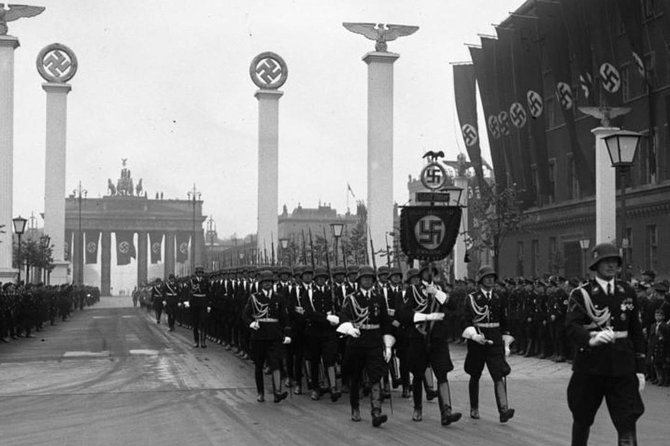
Reviewed · BERLIN THIRD REICH TOURS
Berlin & The Third Reich Private Guided Tour
Berlin’s Nazi past is not confined to museums. It is woven into the streets and buildings around the Brandenburg Gate, where this private four-hour tour links the places where Hitler’s regime took power, ruled, and met its end in 1945.
I like two things in particular: the guide can connect major landmarks to events that are easy to miss when you visit alone, and the private format gives your group room to ask questions. The route also brings together the Holocaust Memorial, the Führerbunker site, and the Reichstag, making the city’s layered past easier to grasp.
The main consideration is the amount of walking and the weight of the subject matter. You’ll spend about four hours on a serious account of dictatorship, war, and genocide, and the Führerbunker is now an unremarkable parking area rather than a preserved site.
- The route links seven central Berlin stops, from Pariser Platz to Checkpoint Charlie.
- The Führerbunker is a place to understand, not a building to enter. The site is now a parking lot with a simple sign.
- Your group is private, with a maximum of 15 people.
- Guides named by past participants include Walid, Campbell, and Gregor. Your assigned guide may be someone else.
- The fixed group price is $329.92, so the per-person cost drops as your group gets larger.
- The tour starts and finishes at the Brandenburg Gate, with pickup offered.
A Four-Hour Walk Through Berlin’s Nazi Past
This tour is built around a useful idea: Berlin’s past is not a story told in one place. The route takes you from grand civic symbols to the unmarked ground where Hitler spent his final days, then onward to a Cold War checkpoint. Along the way, your guide explains how the Nazi regime began, maintained power, and was defeated in 1945.
That context matters. You can see the Brandenburg Gate, Reichstag, or Holocaust Memorial on your own, but a guide can explain how each place fits into a larger sequence of events. The private format also means the pace and conversation belong to your group, rather than to a large crowd trying to keep up.
Expect a serious walk, not a theatrical performance. The subject is brutal, and the value lies in clear explanation and thoughtful attention to the places themselves. If you want a light overview of Berlin’s sights, this is not the right tour. If you want to understand the city’s Nazi-era landmarks as part of a connected story, it has a strong case.
Starting at Pariser Platz and the Brandenburg Gate
The meeting point is at Pariser Platz, beside the Brandenburg Gate. This grand square sits at the end of Unter den Linden, one of Berlin’s best-known avenues, and gives your guide a natural place to begin with the city’s public image and political history.
The gate was once a royal entrance to Berlin under the Hohenzollern family, and one of 18 former city gates. Its meaning changed sharply over time: it survived Napoleon and the Second World War, then stood within the Berlin Wall’s restricted zone for nearly three decades. Today it is a symbol of a reunited Germany.
That shift is a good introduction to the tour’s central theme: Berlin’s landmarks rarely have just one meaning. Your guide can place the gate in the story of the Nazi era while also explaining how its role changed after the war and during the Cold War. The tour begins and ends here, which makes it easy to orient yourself before and after the walk.
Pariser Platz is also a busy public space, so don’t expect a quiet, museum-like start. Its value is as a real city square, where layers of history sit beside present-day life.
More Third Reich tours in Berlin:
- Berlin: Third Reich and Cold War 2 Hour Walking Tour
★ 4.9 · 6,830 reviews - Berlin: Berlin Story Bunker Entry Ticket
★ 4.6 · 6,759 reviews - Berlin’s Best: 2 Hour Walking Tour Third Reich and the Cold War
★ 5.0 · 5,486 reviews
The Reichstag and the Fire That Changed Politics
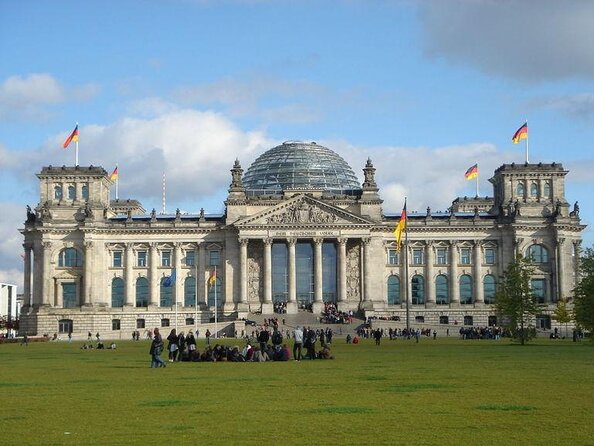
The Reichstag is Germany’s parliament building and one of the tour’s most significant stops. The fire there in 1933 gave Hitler’s government an opportunity to strip away civil liberties and consolidate power. A guide can help explain why that moment mattered, rather than leaving you with a simple story about a dramatic fire.
The building was also fought over during the Battle of Berlin, when German and Soviet forces clashed near the end of the Second World War. Today, the Reichstag is topped by a glass cupola designed by British architect Sir Norman Foster. The modern addition offers a striking contrast with the building’s violent past.
The stop is scheduled for about 10 minutes, so think of it as an exterior introduction, not a full visit to the parliament or cupola. Admission is not included because the tour does not list an interior visit. If you want to go inside the Reichstag separately, you’ll need to arrange that on your own.
The Holocaust Memorial and Its Field of Stone
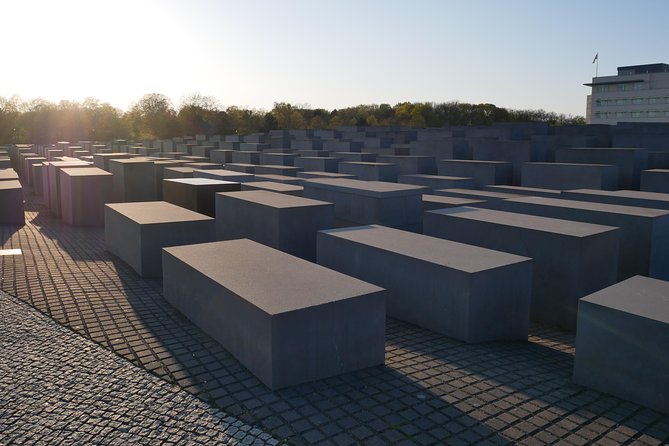
The Memorial to the Murdered Jews of Europe is a central memorial to Jewish victims of the Holocaust. Its broad field of concrete stelae invites visitors to move through the space, but a guide can add essential historical context to an experience that might otherwise remain abstract.
The stop lasts about 20 minutes, the longest listed visit on the route. That gives you more time here than at most other locations, though the memorial is not a museum visit with a detailed indoor exhibition. The site asks for quiet attention; your guide’s explanation can help connect its design and purpose to the history being remembered.
This is one of the tour’s most important stops, and also one of its heaviest. Take time to listen, look, and reflect. The memorial is not simply a photo opportunity between landmarks. Its place in the route helps keep the human cost of Nazi rule at the center of the story.
The Führerbunker Site: Understanding an Absence
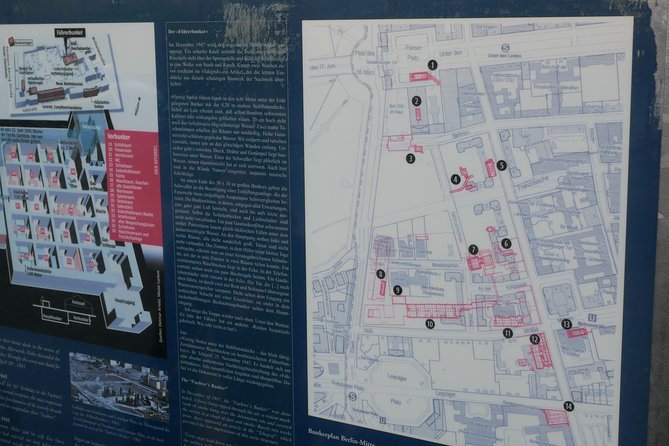
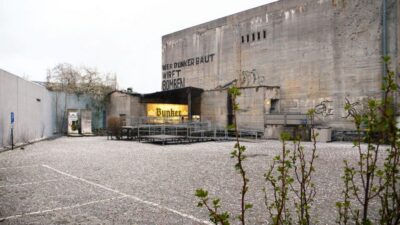
The Führerbunker is the place where Hitler spent his final days, married, and died by suicide during the last days of the war in Europe. There is no bunker to tour. The site is now a parking lot with a simple sign, a fact that can make the location feel surprisingly ordinary.
That ordinariness is part of what makes the stop worth understanding. Without a guide, you might pass by without realizing what happened there, or expect a preserved structure that no longer exists. The guide’s account gives meaning to a place that offers little to see on its own.
The stop is about 15 minutes. Go in expecting explanation rather than spectacle. The site is a reminder that the end of a dictatorship does not always leave behind a grand monument or a dramatic ruin.
More private tours in Berlin:
- Berlin: Private Reichstag and Glass Dome Tour
★ 4.8 · 2,226 reviews - Berlin Private Complete History All Day Walking Tour
★ 5.0 · 474 reviews - Private Walking Tour Berlin Third Reich Hitler and World War II
★ 5.0 · 360 reviews - Private Berlin: Iconic Sights and Hidden Gems Walking Tour
★ 5.0 · 292 reviews
Potsdamer Platz and the City’s Rupture
Potsdamer Platz was one of Europe’s busiest traffic intersections in the 1920s. It was almost completely destroyed during the Second World War, then rebuilt as a modern district in the 1990s and early 2000s.
This stop shows a different face of Berlin. Instead of focusing only on Nazi rule, it helps you see how war reshaped the city and how later generations rebuilt it. The contrast between the old intersection and the modern precinct gives your guide a chance to explain how much of central Berlin had to be made anew.
The scheduled visit is about 10 minutes. The appeal is less about a single preserved wartime structure than about understanding how destruction and redevelopment changed the city’s center. If you’re expecting an intact historic square, you may find the modern setting less evocative. Its place in the route makes sense as a short chapter in a much larger account.
Checkpoint Charlie and Berlin’s Divided Years
The final listed stop is Checkpoint Charlie, the famous Allied checkpoint where American and Soviet forces monitored a Cold War crossing point. It takes the tour beyond the Nazi period, showing how Germany’s defeat led into another era of division and political tension.
The checkpoint was a frontline symbol during the Cold War, but it is important to distinguish that later history from the tour’s main focus on the rise and fall of the Nazi regime. Its inclusion gives you a broader view of how Berlin’s twentieth-century conflicts followed one another.
The stop lasts about 10 minutes, and the tour then returns to its starting point at the Brandenburg Gate. As with several stops, the guide’s explanation is the main attraction. The physical location alone can’t tell you how the division of Berlin shaped daily life or international politics.
What the Private Format Adds
This is a private activity for your group only, with a maximum of 15 people. That can make a real difference on a history-focused tour: you can ask questions, ask your guide to clarify a point, or spend a little more time with a subject that interests you. You won’t be sharing the conversation with a large mixed group.
Past groups have had guides named Walid, Campbell, and Gregor. Their names are useful when you’re comparing options, but they do not guarantee who will lead your tour. The strongest qualities associated with the experience are clear historical explanation and a route that connects major sites rather than treating each as an isolated photo stop.
One person described the experience as a four-hour stroll, with pauses at key locations for conversation. That is a helpful way to picture the rhythm: walking between places, then stopping to talk. The exact amount of walking between each stop is not specified, so wear comfortable shoes and be ready to spend much of the experience on your feet.
Is $329.92 Good Value?
The price is $329.92 per group, for up to 15 people. At the full group limit, that works out to about $22 per person. For two people, it is about $165 each; for a family or a larger group of friends, the per-person cost becomes much more attractive.
You are paying for a private guide and four hours of focused historical interpretation, not admission to attractions. All listed stops have free admission, and the tour is centered on places you can see from public areas. The value depends on how much you want a guide to connect those locations and answer questions along the way.
If you are traveling alone or as a couple, the total price is a substantial outlay. Compare it with a group tour or a self-guided visit if keeping costs down is your priority. But if your group is larger, or if private conversation is important to you, the fixed price can make practical sense.
Practical Details Before You Book
The tour lasts approximately four hours and starts at the Brandenburg Gate in Pariser Platz. It ends back at the same meeting point. Pickup is offered, but the details of pickup are not specified, so confirm the arrangement before relying on it.
You receive confirmation at booking, and the ticket is mobile. Service animals are allowed, and the activity is near public transportation. Most people can participate, though the tour’s walking format and serious subject matter are worth keeping in mind.
The stated stop times add up to about 95 minutes, leaving the rest of the four-hour experience for walking and discussion. The exact schedule can vary, but the listed stops suggest a steady pace with time to hear the story at each location.
Cancellation terms are strict: the booking is non-refundable and cannot be changed. Be sure your plans are firm before paying.
Should You Book This Berlin History Tour?
Book it if you want a private, guide-led account of the Nazi rise to power and the places where its story played out. The best fit is a small group that values questions, context, and a serious look at Berlin’s twentieth century more than interior visits or polished attractions.
Think twice if you want a relaxed sightseeing stroll with little walking, or if you expect to enter the Reichstag or Führerbunker. Those are not part of the listed experience. For a group willing to spend four hours on difficult but essential history, the route offers a clear way to connect the Brandenburg Gate, the Holocaust Memorial, and the less obvious sites in between.
FAQ
How long is the tour?
It lasts approximately four hours.
Where does the tour start and end?
It starts at the Brandenburg Gate in Pariser Platz and ends back at the same meeting point.
What is the maximum group size?
The private tour is for your group only and allows up to 15 people.
How much does the tour cost?
The listed price is $329.92 per group.
Does the tour go inside the Reichstag or the Führerbunker?
No interior visit is listed. The Führerbunker site is currently a parking lot with a simple sign.
Can I cancel or change my booking?
No. The activity is non-refundable and cannot be changed for any reason.
Newest tours in Berlin
- Berlin: guided canoe | kayaktour★ 4.1 · 7 reviews
- Understanding Kreuzberg: The roots of local (sub)culture★ 4.9 · 11 reviews
- Where It All Began: Berlin’s Queer & Trans History Tour★ 4.9 · 6 reviews
- Warnemünde Shore Excursion: Private Sachsenhausen and Berlin Tour★ 5.0 · 12 reviews
- Ultimate E-Bike Tour of Berlin with Beer Garden Stop★ 5.0 · 4 reviews
- Potsdam Highlights – Private sightseeing tour by minibus★ 5.0 · 3 reviews
- Private Potsdam City Tour in an authentic vintage van★ 5.0 · 14 reviews
- Transfer from Berlin Schönefeld Airport (SXF) to Berlin city Hotels – ROUND TRIP★ 4.0 · 3 reviews
Berlin Third Reich Tours, compared.

Third Reich Berlin: Hitler and WWII Walking Tour
Read our review →
Berlin Third Reich Sites: Half-Day Walking Tour
Read our review →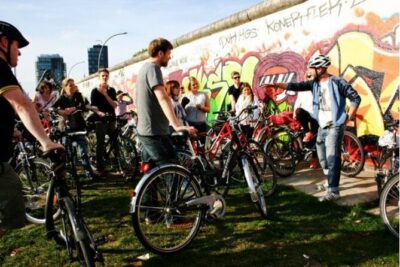
Guided Bike Tour of the Berlin Wall and Third Reich
Read our review →
Hitler’s Germany: Berlin During the Third Reich & WWII
Read our review →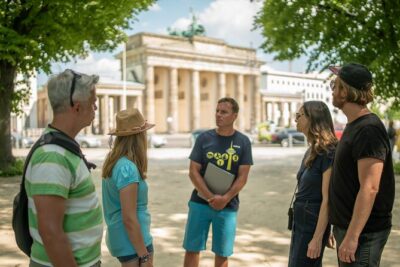
Private Walking Tour Berlin Third Reich Hitler and World War II
Read our review →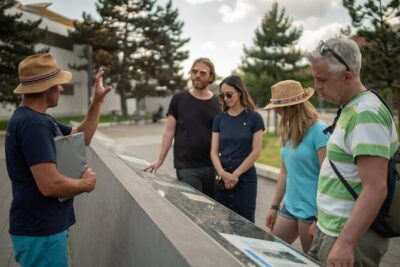
Private Walking Tour: World War 2 and Cold War Sites in Berlin
Read our review →Browse the lists this tour appears in