

Reviewed · BERLIN JEWISH HISTORY TOURS
In Search of Jewish Berlin Walking Tour
Jewish Berlin is best understood on foot, where grand architecture, former community institutions, and memorials sit within a city shaped by both Jewish life and persecution. This three-hour walk links those places with the help of a guide who studies the subject, rather than leaving you to piece the story together alone.
I like the tour’s small group, capped at 10, which leaves room for questions and discussion. I also like its range: you move from the New Synagogue and the Barn Quarter to the memorial for Jewish men arrested by the Nazis, then finish at the Holocaust Memorial.
The main consideration is the price: $156.53 per person is a substantial cost for a three-hour walking tour, and food and drinks are not included. It makes most sense if you want expert context and conversation, not simply a quick look at Berlin’s landmarks.
- A Jewish Studies guide leads the walk, with guides drawn from professors, graduate students, and journalists.
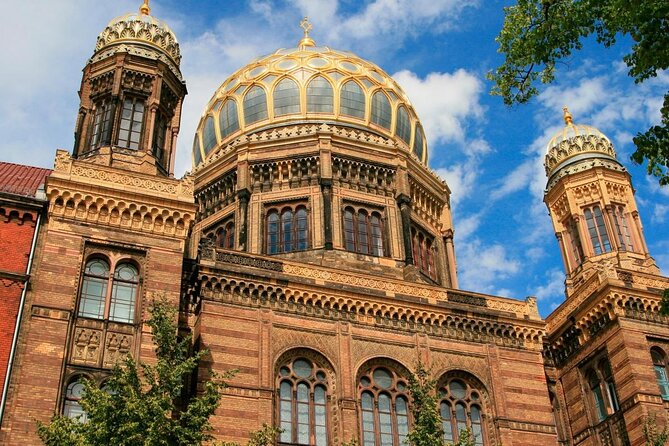
- The New Synagogue anchors the story of Jewish assimilation and the community’s revival in Berlin.
- Auguststraße and the Barn Quarter reveal places tied to Jewish institutions and everyday life.
- The Frauenblock memorial recalls a protest by non-Jewish wives and relatives of arrested Jewish men.
- The Holocaust Memorial provides a sobering final stop, with 2,711 concrete slabs arranged in a maze-like field.
- The group is limited to 10, and the tour lasts about three hours.
Jewish Berlin told through its streets
This walk is not just a sequence of memorials. Its strength is the way it traces Jewish life through places where people lived, studied, worshipped, and built community, before confronting the persecution that devastated that life. The route gives you a framework for understanding the city, while the guide supplies the context that a plaque or building cannot provide on its own.
The tour begins at Rosenthaler Str. 40/41 and ends in Berlin. It is offered in English, and the small group creates a more conversational setting than a large coach tour or a self-guided route. You can ask questions as the story unfolds, and the guide can respond to your interests. One account of the tour describes a guide adapting the walk to the group’s questions, a useful quality when the subject is complex and personal.
Past guides have included Ioana, Forrest, Lee, Heather, and Isabel. Their backgrounds have included long-term residence in Berlin and advanced study of the subject. Your guide is not guaranteed to be any particular person, but the experience is designed around a host who can explain the history and welcome discussion.
The New Synagogue and a changing community
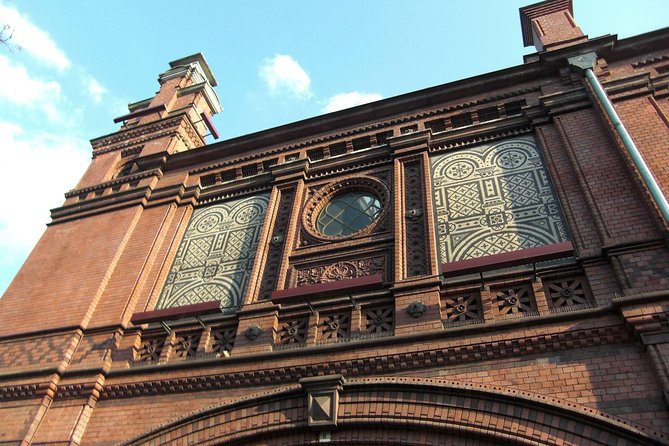
The first stop is the Stiftung Neue Synagoge Berlin, also called the Centrum Judaicum. The building’s grand architecture carries a particular meaning: in the 19th century, it symbolized and celebrated Jewish assimilation in Germany. That makes it more than an impressive façade. It points to a period when Jewish communities were asserting a place in German public life.
The site also connects the past to the present. The New Synagogue is home to a Jewish community reviving in Berlin, so the stop is not only about what was lost. It offers a chance to consider continuity and renewal, themes that can easily disappear if a tour focuses only on persecution.
The scheduled visit is about 20 minutes, and admission is listed as free. The tour does not specify that you enter the building, so treat this as a stop at the site rather than a promised interior visit. If seeing the inside matters to you, check what is open independently before or after the walk.
More walking tours in Berlin:
- Discover Berlin Half-Day Walking Tour
★ 5.0 · 9,624 reviews - Berlin: Third Reich and Cold War 2 Hour Walking Tour
★ 4.9 · 6,830 reviews - Berlin: Discover Berlin Walking Tour
★ 4.9 · 5,998 reviews
Auguststraße and the former Jewish Girls’ School
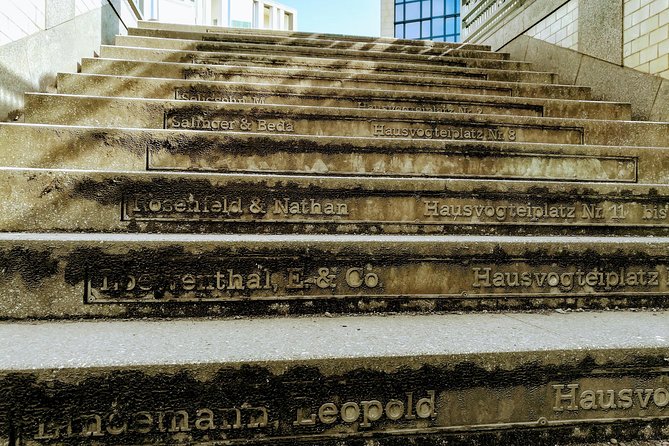
At Auguststraße, the story moves from worship to education and community life. The former Jewish Girls’ School at number 11 to 13 was built between 1927 and 1928 by architect Alexander Beer. Its New Objectivity style makes it a striking marker of the institutions Jewish Berlin had established in the years before Nazi rule.
The building now houses an exhibition hall and a coffee shop, both described as worth a visit. The tour allows about 20 minutes here, enough for the guide to explain the site and its place in the neighborhood, but not necessarily enough for a full visit to an exhibition. If you want to explore the hall or stop for coffee, you may need to return on your own.
This is one of the walk’s most useful stops because it makes the history tangible. The school was not just an architectural project. It was part of a living community, with students and families whose lives were shaped by the institutions around them.
Hackescher Markt and the Barn Quarter
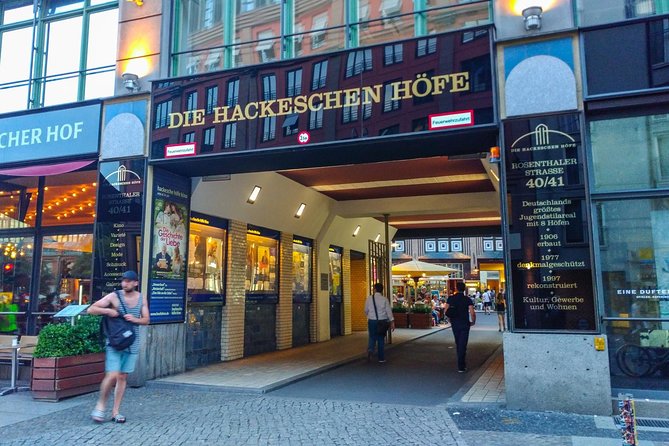
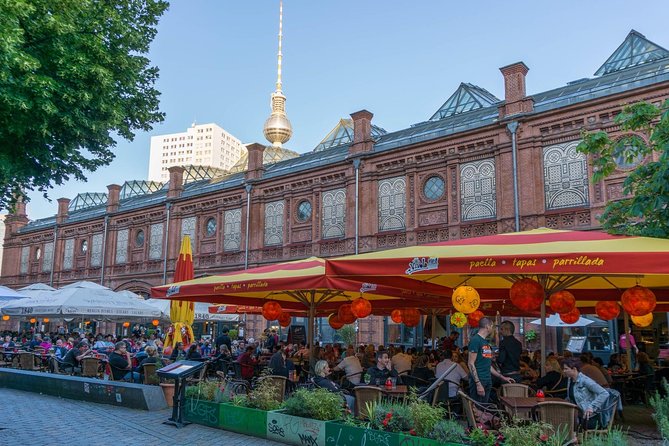
The walk then turns through Hackescher Markt, Spandauer Vorstadt, and the Scheunenviertel, or Barn Quarter. A Jewish community developed around Hackescher Markt, and the tour uses the neighborhood’s graceful architecture to tell stories of German Jewish life in Berlin-Mitte.
Expect about 30 minutes at Die Hackeschen Hoefe. The buildings and courtyards help you picture the area as a place of daily life rather than a collection of isolated historic sites. The guide can connect the streets and architecture to the people who lived and worked here, giving you more than a quick glance at handsome façades.
The neighborhood’s present-day character may make it harder to imagine its earlier life at first. That is where the guided format earns its keep: the story is not always obvious from the street. You get a sense of how Jewish communities were part of the city’s fabric, not separate from it.
The Frauenblock and an act of protest
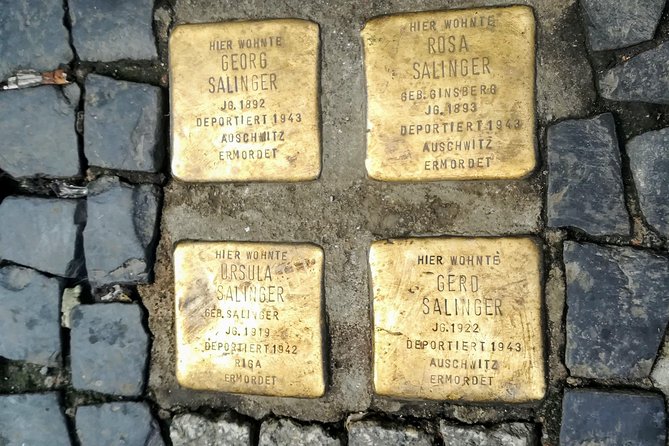
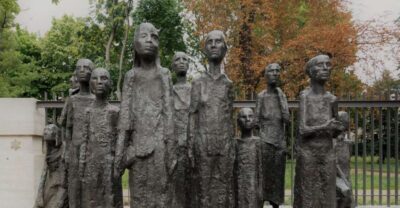
At the Block der Frauen, the focus shifts to a sustained protest by non-Jewish wives and relatives of Jewish men arrested by the Nazis and targeted for deportation. The memorial marks an episode of public resistance and family solidarity amid a system built to isolate and persecute Jewish people.
The stop lasts about 20 minutes. Its subject is specific, but its meaning reaches beyond a single event: it asks what ordinary people could do when the state turned against their families. The guide’s role is especially important here, helping you understand who was arrested, who protested, and why this memorial matters within the wider history.
The site is moving, but it is not a substitute for a full account of Nazi persecution. Rather, it gives the walk a focused human story before the final memorial. The subject is painful, and the tour’s emphasis on discussion and a guide’s care can help you engage with it without rushing past.
More Jewish history tours in Berlin:
- Berlin: Jewish Museum Berlin Entrance Ticket
★ 4.5 · 8,393 reviews - Nazi Berlin and the Jewish Community Tour
★ 4.8 · 55 reviews - Path of Resistance: Berlin’s Hidden Holocaust Stories
★ 5.0 · 33 reviews - Private Tour: Jewish Heritage Walking Tour of Berlin
★ 5.0 · 29 reviews
The Holocaust Memorial’s concrete field
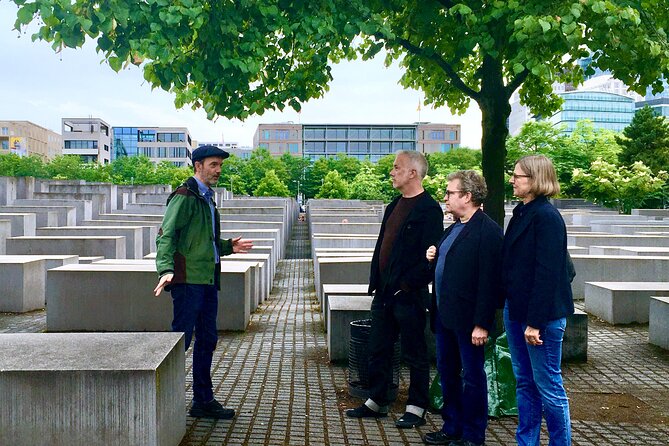
The final listed stop is the Memorial to the Murdered Jews of Europe, designed by architect Peter Eisenman. Its field of 2,711 concrete slabs forms a sobering maze-like space. The design offers no single viewpoint that explains everything; walking through it is a personal encounter with a memorial built to represent Germany’s acknowledgment of the Holocaust.
The tour schedules about 20 minutes here. That is enough to experience the site and hear the guide’s context, though you may want to return later if you would rather spend longer on your own. The memorial is open and exposed, and its effect depends in part on how you move through it. Give yourself room to pause rather than treating it as a photo stop.
Ending here gives the walk a clear emotional arc. Earlier stops show Jewish life and institutions in Berlin; this final site confronts the murder of European Jews. The sequence is powerful, but it can also feel heavy. Plan something quiet afterward if you think you will want time to process what you have seen.
What the small group changes
The group limit of 10 is a meaningful feature, not just a comfort. In a small group, you can ask questions without having to speak over a crowd, and the guide has a better chance of responding to individual interests. One couple described a tour that ended up with just the two of them, which allowed for an especially personal conversation. That is possible, but the maximum group size does not promise a private tour.
The guides’ subject expertise is the tour’s strongest asset. Visitors have praised guides including Ioana, Forrest, Lee, Heather, and Isabel for clear explanations, enthusiasm, openness to questions, and care with sensitive material. One guide was completing a Ph.D. on the topic; another had lived in Berlin for 17 years. Those details point to the kind of informed, personal storytelling this experience aims to provide, while your guide will depend on the date you book.
The walk has a set route, but it does not have to feel like a lecture. The best fit is someone who wants to talk through difficult history, ask follow-up questions, and connect buildings to people. If you prefer to move quickly and take in landmarks without discussion, a self-guided visit may suit you better.
Is $156.53 a fair price?
At $156.53 per person, this is a premium walking tour. The price is easiest to justify if you value a specialist guide and the chance to ask questions in a group of no more than 10. The tour lasts about three hours and covers several distinct sites, so you are paying for interpretation and a carefully linked narrative, not entry to a single attraction.
The listed stops have free admission, but that does not make the tour poor value by itself. The fee covers the guided experience; it does not include food or drinks. Think of it as a history seminar conducted on the streets, with the city’s buildings and memorials serving as the classroom.
The tour is booked, on average, 66 days in advance. If your dates are fixed, plan ahead rather than assuming a spot will be available at the last minute. Group discounts are offered, and there is free cancellation up to 24 hours before the start time. Changes made less than 24 hours ahead are not accepted, and cancellations inside that window are not refunded.
Who should take this walk?
I would choose this tour if you want a clear introduction to Jewish Berlin and value a guide who can handle questions with care. It is especially suited to people interested in the relationship between Jewish community life, Berlin’s architecture, and the Holocaust. The route also works well if you want a guided overview before revisiting one or more sites independently.
It may be less suitable if you have only a short stop in Berlin and want to cover many unrelated sights, or if you are looking for a low-cost walk. Three hours is a meaningful commitment, and the subject is emotionally demanding. The pace is built around discussion and interpretation rather than simply ticking off monuments.
Should you book it?
Book this walk if you want more than dates and plaques. Its route connects a synagogue, a former Jewish school, a historic neighborhood, a protest memorial, and the Holocaust Memorial, while a small group and specialist guide make room for questions. At $156.53, it is not a bargain, but it can be worthwhile if informed interpretation is what you are paying for.
If you would rather explore at your own pace, use the same sites as a self-guided route and save the tour fee. But if Jewish Berlin is a central part of your visit, this is a thoughtful way to understand both the community that shaped these streets and the history that nearly destroyed it.
FAQ
How long is the tour?
The tour lasts about three hours.
What language is the tour offered in?
The tour is offered in English.
How many people can join?
The group has a maximum of 10 travelers.
Where does the tour start?
It starts at Rosenthaler Str. 40/41, 10178 Berlin, Germany.
Are food and drinks included?
No. Food and drinks are not included.
What is the cancellation policy?
You can cancel for a full refund at least 24 hours before the tour start time. Cancellations made less than 24 hours before the start time are not refunded.
Newest tours in Berlin
- Berlin: guided canoe | kayaktour★ 4.1 · 7 reviews
- Understanding Kreuzberg: The roots of local (sub)culture★ 4.9 · 11 reviews
- Where It All Began: Berlin’s Queer & Trans History Tour★ 4.9 · 6 reviews
- Warnemünde Shore Excursion: Private Sachsenhausen and Berlin Tour★ 5.0 · 12 reviews
- Ultimate E-Bike Tour of Berlin with Beer Garden Stop★ 5.0 · 4 reviews
- Potsdam Highlights – Private sightseeing tour by minibus★ 5.0 · 3 reviews
- Private Potsdam City Tour in an authentic vintage van★ 5.0 · 14 reviews
- Transfer from Berlin Schönefeld Airport (SXF) to Berlin city Hotels – ROUND TRIP★ 4.0 · 3 reviews
Berlin Jewish History Tours, compared.
Path of Resistance: Berlin’s Hidden Holocaust Stories
Read our review →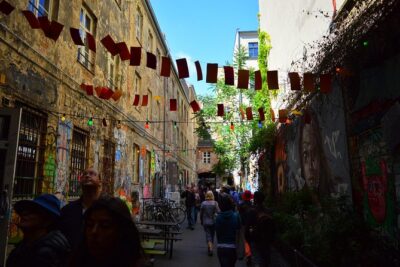
Private Tour: Jewish Heritage Walking Tour of Berlin
Read our review →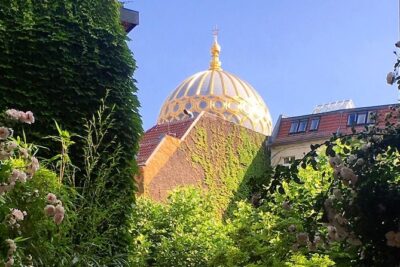
Jewish Berlin: Walking tour The Old Jewish Quarter (private 3 Hours tour)
Read our review →
Browse the lists this tour appears in