

Reviewed · BERLIN WALKING TOURS
Karl-Marx-Allee Walking Tour: Berlin’s Socialist History
Karl-Marx-Allee was built to make East Germany’s socialist project visible in brick and stone. Walking past its huge residential blocks, you can see how architecture served both practical needs and political image-making, then hear how the street’s construction helped fuel a revolt that nearly toppled the government.
I like that this tour links impressive buildings to the people who lived with their consequences, rather than treating the street as a photo backdrop. I also like its wide historical lens: you’ll hear about the 1953 uprising, hidden Stasi surveillance, and today’s protests over rising living costs.
One consideration: the outing is described as two hours overall, while the guided walk itself is listed as 1.5 hours. There is also a small difference in the stated end point, so confirm where the group finishes before you set off for your next stop.
- See socialist classicism at monumental scale: The long blocks were East Germany’s biggest reconstruction project, designed to make a forceful statement after wartime destruction.
- Trace the street’s changing architectural ideals: Earlier postwar modernist buildings sit within a story of shifting ideas about what socialist housing should look like.
- Understand the June 1953 uprising: The building project’s demands helped spark a workers’ revolt that threatened the young East German state.
- Look beyond the polished façade: The tour covers the Stasi’s concealed wiretaps and listening stations.
- Spot film locations: Karl-Marx-Allee has appeared in The Lives of Others and The Queen’s Gambit.
- Connect the past to today: The old parade route now features in local protests against gentrification and rising costs.
Reading Karl-Marx-Allee from Frankfurter Tor
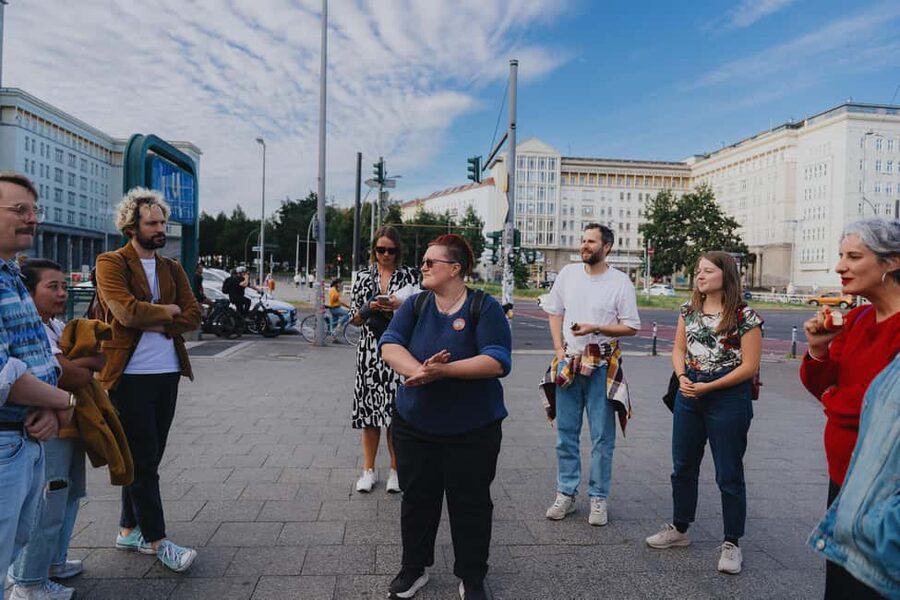
Meet outside Frankfurter Tor U-Bahn station, at the corner of Warschauer Straße and Karl-Marx-Allee. The guide is identified by an orange umbrella, a simple marker that should help you find the group amid the station area.
From there, the route follows Karl-Marx-Allee toward Strausberger Platz. The buildings are the main exhibit: instead of relying on a gallery or a film, the guide uses the street itself to explain how East Germany wanted its capital to look and feel.
Give yourself a moment to take in the scale. The housing blocks were intended to impress, and the experience of walking beside them is part of the point. Their grand proportions can make an individual feel small, which helps explain how architecture could express the authority and ambition of a state.
The route listing describes about 1.5 hours of guided walking within a two-hour activity. That leaves some uncertainty about how the total time is divided, so avoid scheduling a tight connection immediately afterward. The finish is listed as U Strausberger Platz, although the meeting details also say the activity ends back at the starting point. Check the exact arrangement before you book.
From wartime ruins to a socialist showcase
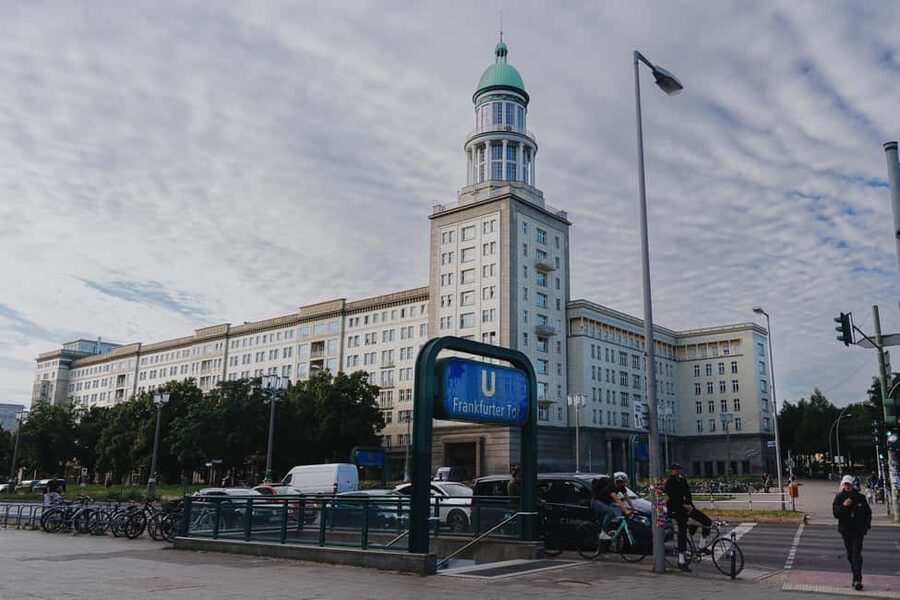
Karl-Marx-Allee emerged from the ruins of postwar Berlin as the centerpiece of East Germany’s national reconstruction programme. Thousands of volunteers worked day and night on the project. The scale and pace of construction tell a story about a state trying to rebuild a city while presenting its own political vision as the answer to the wreckage.
The avenue was not simply a collection of homes. It was meant to show what socialist life could offer, with cafés, restaurants, and well-stocked shops forming part of an image of comfort and abundance. A guide can help you notice the gap between that public picture and the more complicated realities of life under the East German regime.
You’ll also encounter a less imposing architectural chapter. Modernist buildings from the immediate postwar years reflect earlier utopian ideas about city planning. Later, the new regime rejected that style and put forward a different idea of socialist living. Fast-growing poplar trees were used to screen some of those earlier buildings from passersby, a small detail that makes the street’s changing architectural policy easier to picture.
That contrast gives the walk more depth than a tour focused only on the grand façades. The avenue records competing ideas about how people should live, what a city should look like, and which parts of the past a government wanted people to see.
More walking tours in Berlin:
- Discover Berlin Half-Day Walking Tour
★ 5.0 · 9,624 reviews - Berlin: Third Reich and Cold War 2 Hour Walking Tour
★ 4.9 · 6,830 reviews - Berlin: Discover Berlin Walking Tour
★ 4.9 · 5,998 reviews
The 1953 uprising behind the monumental blocks
The most startling part of the street’s story is the link between its construction and the East German uprising of June 1953. Disgruntled workers began a mass revolt that came close to bringing down the young socialist government. The ambitious reconstruction project, meant to advertise the state’s strength, also contributed to the conditions that put its survival at risk.
That reversal makes the architecture worth looking at closely. The blocks were built to project confidence, but the human effort behind them was not just a triumphal tale of rebuilding. The tour connects the physical project with workers’ discontent and political unrest, helping you see the avenue as a place where state plans met ordinary lives.
The supplied outline does not specify exactly which buildings or points the guide pauses at for this history. Expect the story to be told along the avenue, rather than assume a particular interior visit or a separate museum stop. If you want a close look at a specific façade or historical detail, ask your guide while walking.
The hidden side of the socialist ideal
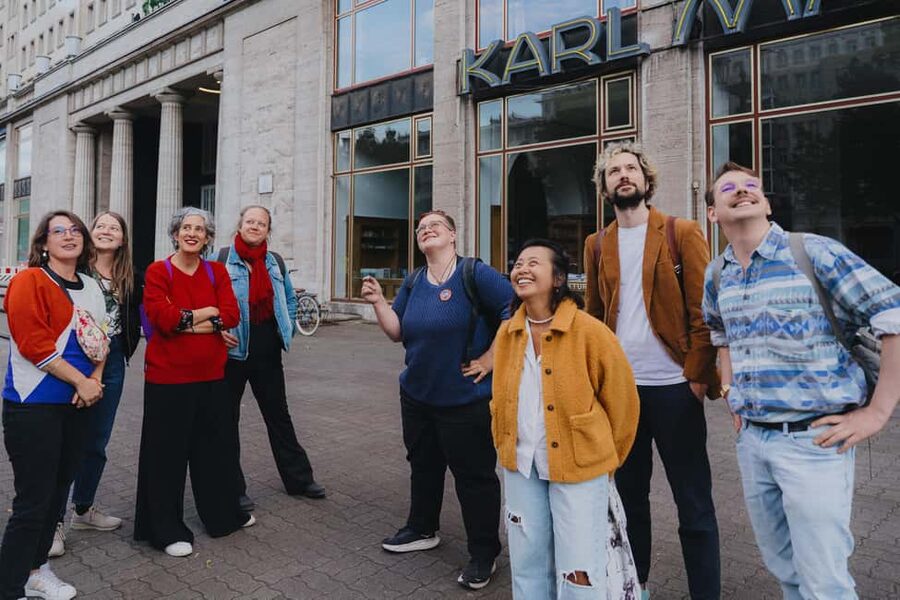
Karl-Marx-Allee offered a carefully presented image of East Berlin life, but the tour also addresses the surveillance system behind the public façade. The East German secret police, the Stasi, used wiretaps in flats and listening stations in attics. These were meant to remain unseen, which makes the contrast with the avenue’s conspicuous architecture especially sharp.
The subject matters because it changes how you read the street. Cafés, shops, and housing may suggest a confident public life, while hidden listening equipment points to a state that monitored its own people. You won’t just be looking at buildings as design objects; you’ll be considering how public space and private life could tell very different stories.
The tour also promises a look at filming locations used in The Lives of Others and The Queen’s Gambit. No specific scenes or addresses are provided, so treat this as an added thread rather than a guaranteed stop at a particular doorway. It can still be useful to see how the avenue’s distinctive appearance has served stories about different periods and political worlds.
A street that keeps changing its role

After the Berlin Wall fell, Karl-Marx-Allee was left in disrepair and began to look like a relic from a past that had lost its audience. That phase did not last forever. In a city facing a housing crisis, the avenue drew renewed attention from real estate interests.
Today, the street is no longer a boulevard for socialist parades. It has become a setting for local protests against gentrification and rising living costs. That present-day connection is one of the tour’s strongest ideas: the buildings are not frozen history, but part of an ongoing argument about who gets to live in Berlin and what urban change costs.
I appreciate this final turn because it avoids the easy conclusion that the story ended with the fall of the Wall. The political system changed, but disputes over housing and the use of the city remain. You leave with a better sense of how a single avenue can serve first as a reconstruction project, then as a socialist showpiece, and later as a focus of community protest.
More history tours in Berlin:
- Berlin: Natural History Museum Entrance Ticket
★ 4.6 · 3,382 reviews - Berlin: World Heritage Cruise to Potsdam
★ 4.5 · 1,435 reviews - Berlin Historical Highlights Walking Tour
★ 4.9 · 657 reviews - Berlin Private Complete History All Day Walking Tour
★ 5.0 · 474 reviews
What the $23 price gets you
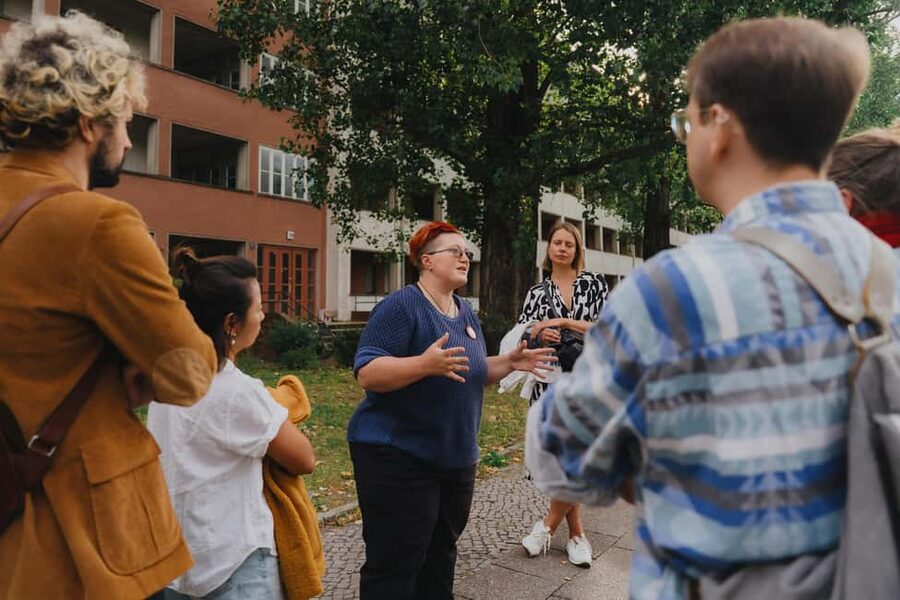
At $23 per person, the fee covers a live guide and a two-hour activity. The value is less about getting access to an attraction and more about having someone connect the avenue’s architecture with the political events and daily realities that shaped it. If you simply walk the street on your own, you’ll see the scale; a guide can explain why it was built that way and what the buildings conceal.
The experience is a good fit if you enjoy urban history, architecture, or the Cold War and want a grounded introduction to East Berlin. It may also suit you if you have seen either film and want to recognize the avenue as a real place with a history beyond its role on screen.
The tour is not suitable for children under 10. Bring comfortable shoes, as the experience is a walking tour. It is listed as wheelchair accessible, and tours are offered in English and German. The guide is included; no other inclusions are specified, so don’t assume extras are part of the price.
A guide named Martina has been praised for paying attention to curious questions rather than sticking rigidly to a script. That’s a useful sign for a history walk, where a good question can help link a grand political story to a detail you have just noticed. Guides can vary, though, so don’t book on the assumption that Martina will lead your departure.
Should you book this Karl-Marx-Allee walk?

Book it if you want to understand why this unusually monumental street exists, and how its story connects architecture, forced political image-making, worker unrest, surveillance, and today’s housing debates. At $23, it offers a compact way to put those subjects together, with the street itself as the primary evidence.
Skip it if you mainly want interiors, a long list of building visits, or a tour built around film trivia. The available details describe a guided walk along the avenue, not access to buildings or an extended film-location itinerary. Before booking, confirm the end point because the route information names Strausberger Platz while the meeting details say the activity ends back at the meeting point.
FAQ

How much does the tour cost?
The tour costs $23 per person.
How long does the tour last?
The activity is listed as two hours. The guided tour along Karl-Marx-Allee is described as 1.5 hours.
Where does the tour start?
Meet outside Frankfurter Tor U-Bahn station, on the corner of Warschauer Straße and Karl-Marx-Allee. Look for a guide holding an orange umbrella.
Where does the tour finish?
The route information names U Strausberger Platz as the finish. The meeting details also say the activity ends back at the meeting point, so confirm the precise end point before setting other plans.
Which languages are available?
The live guide leads tours in English and German.
Is the guide included in the price?
Yes. A guide is included.
Is the tour wheelchair accessible?
Yes, the activity is listed as wheelchair accessible.
What should I bring?
Wear comfortable shoes for the walking tour.
Is the tour suitable for children?
It is not suitable for children under 10 years old.
Can I cancel or pay later?
You can cancel up to 24 hours in advance for a full refund. The activity also offers reserve now and pay later booking.
Newest tours in Berlin
- Berlin: guided canoe | kayaktour★ 4.1 · 7 reviews
- Where It All Began: Berlin’s Queer & Trans History Tour★ 4.9 · 6 reviews
- Understanding Kreuzberg: The roots of local (sub)culture★ 4.9 · 11 reviews
- Warnemünde Shore Excursion: Private Sachsenhausen and Berlin Tour★ 5.0 · 12 reviews
- Ultimate E-Bike Tour of Berlin with Beer Garden Stop★ 5.0 · 4 reviews
- Potsdam Highlights – Private sightseeing tour by minibus★ 5.0 · 3 reviews
- Private Potsdam City Tour in an authentic vintage van★ 5.0 · 14 reviews
- Transfer from Berlin Schönefeld Airport (SXF) to Berlin city Hotels – ROUND TRIP★ 4.0 · 3 reviews
Berlin Walking Tours, compared.



Third Reich Berlin: Hitler and WWII Walking Tour
Read our review →

Explore Berlin: Walking Tour of All The Iconic Sites
Read our review →Browse the lists this tour appears in