
Reviewed · BERLIN COLD WAR TOURS
Karl-Marx-Allee Tour: Life and Architecture in East Berlin
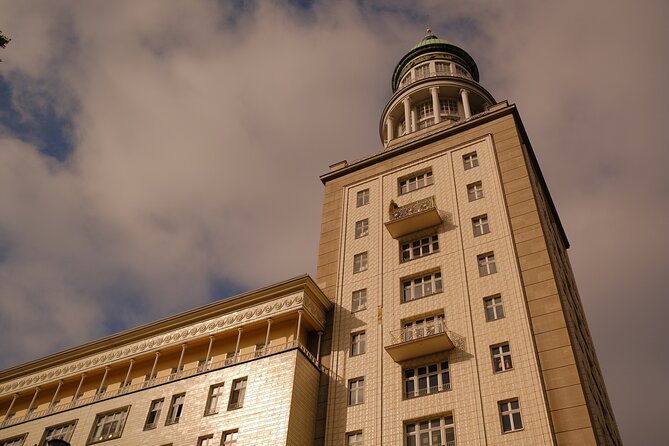
Karl-Marx-Allee is more than a grand boulevard: it is a street built to make a political argument. On this two-hour walk, architecture tells the story of East Germany, from postwar experiments to monumental socialist design and the workers’ uprising of 1953.
I like two things in particular: the route pairs famous buildings with the people and politics behind them, and the group limit of 15 leaves room for a more personal discussion. One consideration: this is a focused history and architecture tour, so it may not suit you if you prefer a broad overview of Berlin or a faster, less detailed walk.
Key points
- Frankfurter Tor’s twin towers introduce the boulevard’s carefully planned socialist style.
- Laubenganghäuser reveal a postwar architectural vision that the East German regime soon rejected.
- The Hochhaus at Weberwiese began as a prototype, with luxury features that gave it political value.
- A stop at the 1953 uprising memorial connects workers’ frustration to a major challenge to East German rule.
- Café Sibylle and Strausberger Platz link everyday life, changing ideology, and the boulevard after reunification.
A boulevard built to make a point
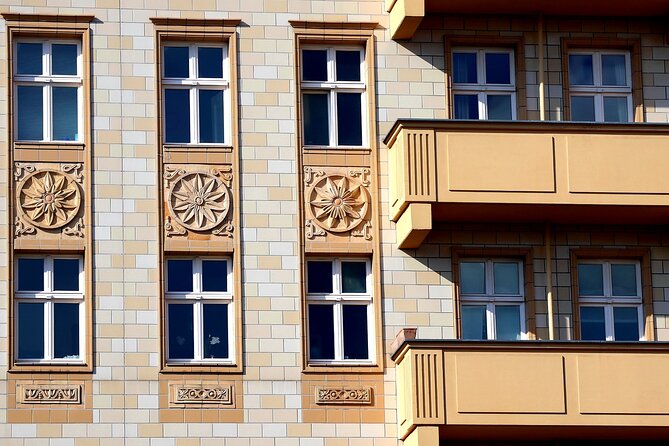
Karl-Marx-Allee was planned as a grand socialist street in the early 1950s. Its size and formal architecture were meant to express a new order, but its history is less tidy than the wide facades suggest. This route explores the hopes behind the building program, the lives shaped by it, and the moments when official plans met public dissent.
That makes the walk useful even if you are not an architecture specialist. Instead of seeing a row of impressive buildings and moving on, you can learn why styles changed, how the state used construction for political ends, and what the street meant to residents.
The tour begins at U Frankfurter Tor and finishes at Strausberger Platz. It lasts about two hours, is offered in English, and includes an expert local guide. The group is limited to 15 people, a practical size for a route where the details on a facade and a guide’s explanation both matter.
More Cold War tours in Berlin:
- Berlin: Third Reich and Cold War 2 Hour Walking Tour
★ 4.9 · 6,830 reviews - Berlin’s Best: 2 Hour Walking Tour Third Reich and the Cold War
★ 5.0 · 5,486 reviews - Berlin: DDR Museum Tickets
★ 4.3 · 3,443 reviews
Frankfurter Tor’s planned symmetry
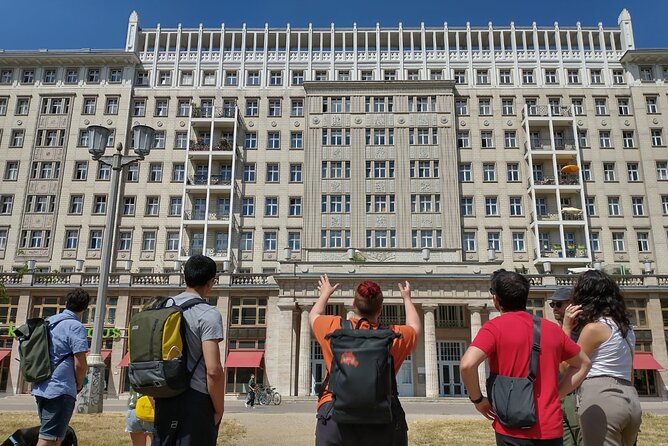
At Frankfurter Tor, the matching towers designed by Hermann Henselmann set the visual tone. The symmetry is deliberate and hard to miss. Your guide explains how plans for Germany’s first socialist street took shape in the early 1950s, when rebuilding was also a public display of state ambition.
The stop lasts about 20 minutes. That gives the guide time to connect the architecture with the national rebuilding program, which mobilized thousands of volunteers. The scale of that effort helps explain why the boulevard was more than a housing project: it was a statement about what East Germany wanted to become.
Admission is free at the stops, so the price goes toward the guided experience rather than entry fees. At this first stop, the value is the context: the towers make a stronger impression once you know the political hopes built into their design.
Laubenganghäuser and a rejected modernist future
The next stop shifts the architectural mood. At the Laubenganghäuser, you see work by Hans Scharoun from the years just after World War II. His modernist ideas grew out of a destroyed Berlin and offered a different way to think about how people might live in a rebuilt city.
The contrast matters. The East German regime soon rejected Scharoun’s urban ideas, and the tour uses that change to show how quickly the official vision for the city could shift. Buildings here are not simply examples of one style or another; they preserve a debate about what reconstruction should achieve.
The stop is about 15 minutes. If you are mainly interested in monumental boulevards, this section may feel less grand than what comes next, but it gives the route needed variety. It also makes clear that postwar Berlin’s architectural story did not follow one straight path.
Weberwiese, where the prototype became propaganda
At the Hochhaus an der Weberwiese, the tour focuses on a building that served as a model for the later Karl-Marx-Allee. Its first tenants received a level of comfort described as unprecedented at the time, a detail that makes the building’s political role easier to grasp.
The project became a propaganda tool and drew interest from Western architects. That combination gives this stop an interesting edge: the building was both a place to live and an object meant to impress observers beyond East Berlin. You can see how housing, prestige, and ideology became tied together.
Plan for about 20 minutes here. It is one of the longer stops, and for good reason: the building helps explain the boulevard’s development rather than simply adding another striking facade to the walk.
Same city, a different kind of day:
- Berlin: Reichstag, Dome and Government District Guided Tour
★ 4.7 · 18,288 reviews - Berlin: 1-Hour City Tour by Boat with Guaranteed Seating
★ 4.3 · 16,993 reviews - Berlin: Boat Tour Along the River Spree
★ 4.4 · 11,252 reviews - Discover Berlin Half-Day Walking Tour
★ 5.0 · 9,624 reviews
The 1953 uprising and its contested memorial
The memorial to the workers’ uprising of June 17, 1953, brings the tour’s political story into sharp focus. Disgruntled workers began a mass uprising here that nearly toppled East Germany’s socialist government. The event complicates any simple picture of a population quietly accepting state decisions.
The monument itself is described as controversial, and that is part of the stop’s value. Memorials express choices about what to remember and how to frame it. Here, the guide can connect the physical marker with a moment when workers challenged the government behind the boulevard’s grand promises.
This stop lasts about 20 minutes. Its subject is weightier than the architectural stops, but it gives the walk a human and political center. If your interest is daily life under East German rule, this is one of the sections to listen to closely.
Café Sibylle and the street’s changing symbols
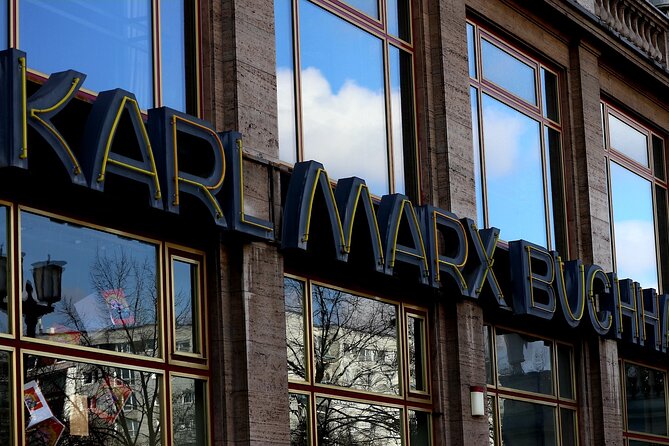
Café Sibylle offers a more everyday angle on Karl-Marx-Allee. It was one of the boulevard’s most exclusive cafés during the East German period, and the tour connects it with a nearby statue of Joseph Stalin. That statue stood close by until 1961.
The contrast between a café and a dictator’s statue is telling. Public space could carry official symbols while also serving as a place for ordinary social life. The guide helps connect those layers, rather than treating the boulevard as a collection of state buildings with no human use.
The stop takes about 15 minutes. It is a useful pause in the route’s sequence of grand architecture and political conflict, and it gives you a way to think about how residents used the street beyond the intentions of planners.
Marx, ideology, and daily routines
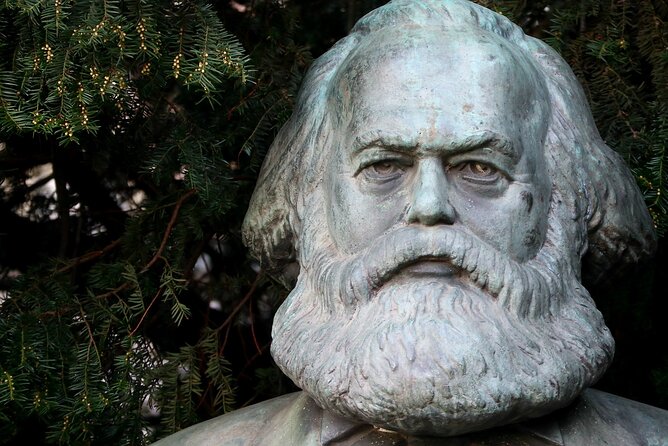
At the Karl Marx bust, the tour turns to the author of The Communist Manifesto and the effect socialist ideology had on everyday life in East Berlin. This is a short stop, around 15 minutes, but its subject reaches beyond the statue itself.
The point is not only who Marx was. It is how political ideas were made visible in public spaces and tied to daily life. If you arrive with little background on East German ideology, this stop can help connect the symbols you have seen with the system that gave them meaning.
It is also a good moment to ask questions. The tour’s small group size should make it easier to follow a complex subject than it would be on a large coach tour, though the maximum is still 15 people, not a private walk.
Strausberger Platz and the boulevard after the Wall
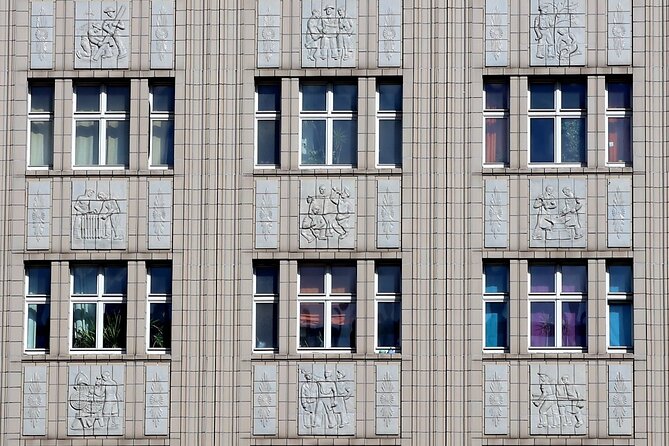
The final stop is Strausberger Platz, another major example of Hermann Henselmann’s style. The route ends here after about 15 minutes at the square, where the guide discusses life on Karl-Marx-Allee after the fall of the Berlin Wall and the street’s present-day role.
Ending at the square gives the tour a useful sense of change. The buildings remain, but the political conditions around them do not. That distinction helps you read the boulevard as a place that has outlasted the government that shaped it.
The endpoint is on the eastern side of the Strausberger Platz roundabout, about a 10-minute walk from Alexanderplatz. This makes it straightforward to continue exploring the area or head back toward central Berlin after the tour.
What a two-hour walk can and cannot cover
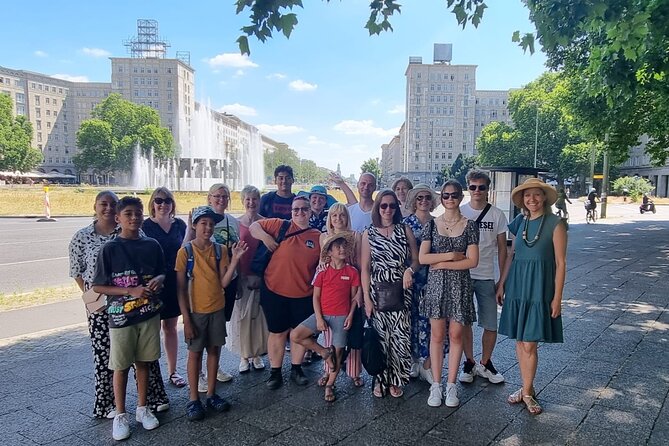
Seven stops in about two hours make for a brisk but focused visit. The listed stop times add up to two hours, so expect the guide to keep the group moving and the discussion centered on the route’s main themes. You get a compact introduction rather than an exhaustive account of East Berlin.
That is a good trade for a short stay in Berlin. The tour covers architectural contrasts, state rebuilding, the 1953 uprising, ideology, and life after reunification without requiring a full day. If you want to explore every building at length or spend time inside the café, you may want to return to the area on your own.
The experience is offered in English, uses a mobile ticket, and starts near public transportation. Most people can participate, and service animals are allowed. Since the tour depends on good weather, dress for an outdoor walk; if poor weather forces cancellation, you are offered another date or a full refund.
Is $30.01 a fair price?
At $30.01 per person, this tour’s value depends on how much you want the history explained. The stops themselves have no admission charge, so you are paying for the guide’s interpretation and the structure of the route. That can be worthwhile on a street where a building’s political meaning is not always obvious from its exterior.
The small group cap also helps the price make sense. With no more than 15 people, a guide can keep the group together and respond to questions more easily than on a large tour, though the experience is still shared with others.
The strongest praise for guides associated with this tour centers on clear storytelling, thorough preparation, humor, and the ability to make a difficult period understandable. Martina is one guide connected with the walk. If she leads your departure, expect a strong focus on the links between architecture, political power, and residents’ hopes. Guide assignments are not specified in advance, so do not book on the assumption that a particular person will lead.
Who should book this walk?
I would choose this tour if you have already seen Berlin’s best-known sights and want to understand a less familiar part of its history through the buildings themselves. It also suits you if architecture interests you, but you want more than a style lesson: the route connects design to state policy and everyday life.
The tour is a good fit for a short visit because it takes about two hours and stays in one part of East Berlin. It can also work for older teenagers interested in history. The subject is serious, but a lively guide can make the political detail approachable without turning the walk into a lecture.
You may prefer to explore on your own if you want a general introduction to Berlin, a private guide, or a slower visit with time to linger at each stop. This route is specific by design. Its reward is a more grounded understanding of one boulevard and the ideas built into it.
Should you book the Karl-Marx-Allee tour?
Book it if you want to see how architecture and politics shaped East Berlin, and if you have two hours for a guided walk rather than a broad city overview. The route’s best feature is its range: a modernist experiment, a socialist prototype, a workers’ revolt, and the changing meanings of public space all fit into one stretch of the city.
At $30.01, I see the strongest value for curious visitors who enjoy a well-told historical story and want a guide to point out what façades alone cannot explain. If that sounds like your kind of Berlin afternoon, this is a focused and worthwhile choice.
FAQ
How long is the Karl-Marx-Allee tour?
It lasts about two hours.
What is the tour price?
The listed price is $30.01 per person.
What language is the tour offered in?
The tour is offered in English.
Where does the tour start?
It starts at U Frankfurter Tor, 10243 Berlin.
Where does the tour end?
It ends at Strausberger Platz, on the eastern side of the roundabout. The endpoint is about a 10-minute walk from Alexanderplatz.
How large is the group?
The tour has a maximum of 15 travelers.
What happens if bad weather cancels the tour?
You will be offered a different date or a full refund. You can also cancel for a full refund if you do so at least 24 hours before the experience starts.
Newest tours in Berlin
- Berlin: guided canoe | kayaktour★ 4.1 · 7 reviews
- Understanding Kreuzberg: The roots of local (sub)culture★ 4.9 · 11 reviews
- Where It All Began: Berlin’s Queer & Trans History Tour★ 4.9 · 6 reviews
- Warnemünde Shore Excursion: Private Sachsenhausen and Berlin Tour★ 5.0 · 12 reviews
- Ultimate E-Bike Tour of Berlin with Beer Garden Stop★ 5.0 · 4 reviews
- Potsdam Highlights – Private sightseeing tour by minibus★ 5.0 · 3 reviews
- Private Potsdam City Tour in an authentic vintage van★ 5.0 · 14 reviews
- Transfer from Berlin Schönefeld Airport (SXF) to Berlin city Hotels – ROUND TRIP★ 4.0 · 3 reviews
Berlin Cold War Tours, compared.

Cold War, Berlin Wall, Spies and the East Side Gallery
Read our review →

Private Walking Tour: World War 2 and Cold War Sites in Berlin
Read our review →Browse the lists this tour appears in