
Reviewed · BERLIN WALKING TOURS
Private walking Tour: Berlin Architecture Tour
Berlin’s architecture tells the story of a city split by war, shaped by rival political systems, and rebuilt in strikingly different ways. I especially like the contrast between the monumental historic buildings around Museum Island and the bold modern design of the Philharmonie, and the private format lets you ask questions and steer the conversation toward what interests you.
I also like that this is more than a parade of façades: guides connect design choices to Berlin’s divisions, rebuilding and urban renewal. The main consideration is the price, $191.87 per person, and the wide-ranging route. In four hours, some stops are necessarily brief, so talk with your guide at the start about what you most want to see.
- Museum Island’s architectural mix: Compare neoclassical, Baroque and restored postwar buildings along the Spree.
- A private, adaptable route: Your guide meets you at your central Berlin hotel, and you can request specific sights or themes.
- Cold War contrasts: See how architecture in former East and West Berlin reflects different political eras.
- A choice of pace and transport: The experience can be done on foot or by bike.
- Guides with different strengths: Past visitors singled out Sara, Thomas, Tom, Daniel, Heiko, Ariel and Tarek for clear explanations and flexible pacing. Guide availability varies.
Berlin’s buildings make the city’s history visible
This tour works best when you treat architecture as a way to read Berlin. A neoclassical façade, a socialist-era apartment block and a glass office tower are not just different styles. They point to different moments in the city’s past, including the division between East and West and the decisions made after reunification.
Your private guide can help join those dots. The experience is designed to be customized, so tell the guide early if you are drawn to modern design, historic monuments, urban planning or the political story behind the buildings. Past guides have included Sara, an architect, as well as Thomas, Tom, Daniel, Heiko, Ariel and Tarek. Names are not guaranteed, but the strongest feedback consistently concerns guides who explain what architects were trying to achieve, rather than simply naming dates and styles.
The planned experience lasts about four hours and includes pickup and drop-off at your hotel. You can choose to walk or cycle. The route covers a broad swath of central Berlin and several distinct neighborhoods, so it is worth agreeing on priorities before setting out. A long list of places does not mean you will have time to explore every building in depth.
Museum Island: a compact lesson in changing styles
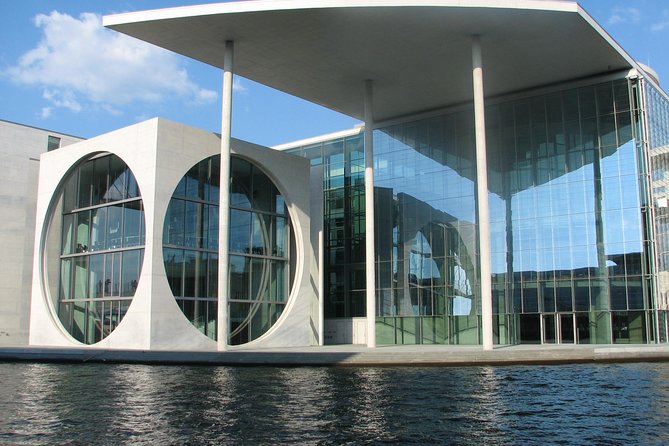
Museum Island is a strong place to begin because its buildings show several architectural eras in one concentrated area. The Altes Museum is a neoclassical landmark, with a broad portico and columns that recall ancient Greek temples. Nearby, the Bode Museum adds a prominent dome and more curving forms, while the restored Neues Museum brings historical fabric together with modern design.
The route also identifies the Pergamon Museum as an architectural highlight. The stop is scheduled for about 20 minutes, with no admission ticket required for the tour itself. That is enough time for an outside look and a conversation about the ensemble, not a museum visit. Museum Island’s appeal is the way its buildings face the river and one another, making the whole area feel like a designed cultural district.
If you want to spend time inside a museum, raise that before the tour begins. The schedule is built around architecture and city history, and the listed stop does not include museum entry.
More walking tours in Berlin:
- Discover Berlin Half-Day Walking Tour
★ 5.0 · 9,624 reviews - Berlin: Third Reich and Cold War 2 Hour Walking Tour
★ 4.9 · 6,830 reviews - Berlin: Discover Berlin Walking Tour
★ 4.9 · 5,998 reviews
Gendarmenmarkt: three buildings, one composed square
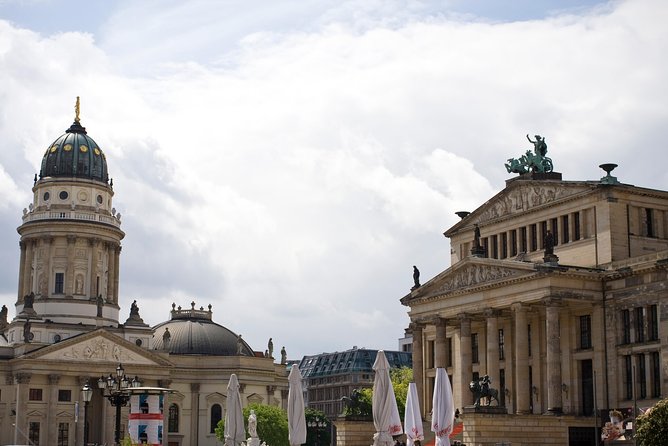
At Gendarmenmarkt, three landmark buildings form a striking architectural group: the German Cathedral, the French Cathedral and Schinkel’s Konzerthaus. The square also has a statue of poet Friedrich Schiller at its center. Your guide can explain how the buildings relate to one another and why this gathering of civic and cultural architecture matters to Berlin’s story.
The planned visit is about 15 minutes. That is a short stop, but the square rewards a little time to look from one side to the other and notice how the domed cathedrals frame the concert hall. If this is a priority, ask whether the route can allow more time here. It is also one of the clearest places to see the value of a guide who can explain design details while you take in the overall composition.
The Philharmonie and Kulturforum: West Berlin’s cultural answer
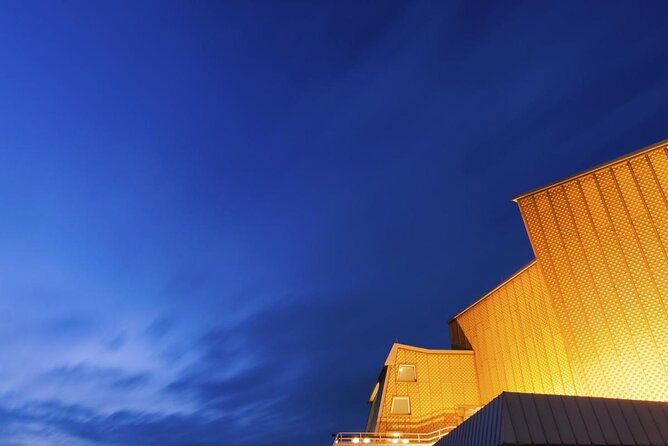
The Berliner Philharmonie is one of the tour’s most distinctive modern buildings. Its asymmetrical, tent-like exterior breaks from the formal symmetry of older concert halls. Inside, the circular arrangement brings the audience close to the performers, though the tour stop described here is for seeing the building, not attending a concert.
The Philharmonie sits within the Kulturforum, a group of cultural institutions developed in the 1950s and 1960s at the edge of West Berlin. After the Wall left many cultural assets on the eastern side, West Berlin built a new center for museums, concert halls, libraries and institutes. That context makes the Kulturforum more than a collection of modern buildings: it shows how urban planning became part of the city’s response to division.
The tour highlights a photo stop at the Expressionist Philharmonic Hall. You might find the area less immediately picturesque than Gendarmenmarkt, but its architectural ideas and postwar purpose are worth looking at closely.
Reichstag and Pariser Platz: old authority, new openness
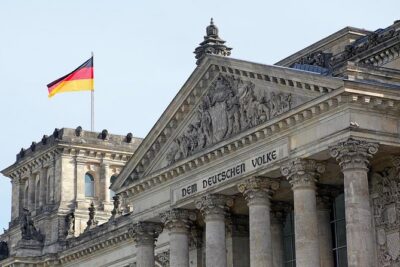
The Reichstag combines a grand 19th-century exterior with a modern glass dome designed by Norman Foster during the building’s renovation after reunification. The contrast gives your guide a useful way to discuss how Berlin has reworked symbols of state power. The dome is associated with transparency and democracy, while the older façade speaks in a more traditional, monumental language.
The itinerary allows about 10 minutes at the Reichstag. Do not assume that this includes entry to the dome. The listed stop does not specify interior access, and dome visits require arrangements beyond simply viewing the building from outside. If entering is important to you, clarify that with the tour provider before booking.
Nearby Pariser Platz gathers several styles around the Brandenburg Gate. The square includes the classical French Embassy and Hotel Adlon, the minimalist American Embassy, the Academy of Arts and Frank Gehry’s curving DZ Bank building. The mix is a vivid example of how new construction has been fitted into a historically charged setting. The planned stop is about 20 minutes, enough for a guided look and photos, though not an in-depth visit to each building.
More private tours in Berlin:
- Berlin: Private Reichstag and Glass Dome Tour
★ 4.8 · 2,226 reviews - Berlin Private Complete History All Day Walking Tour
★ 5.0 · 474 reviews - Private Walking Tour Berlin Third Reich Hitler and World War II
★ 5.0 · 360 reviews - Private Berlin: Iconic Sights and Hidden Gems Walking Tour
★ 5.0 · 292 reviews
Potsdamer Platz: a city rebuilt from a dividing line
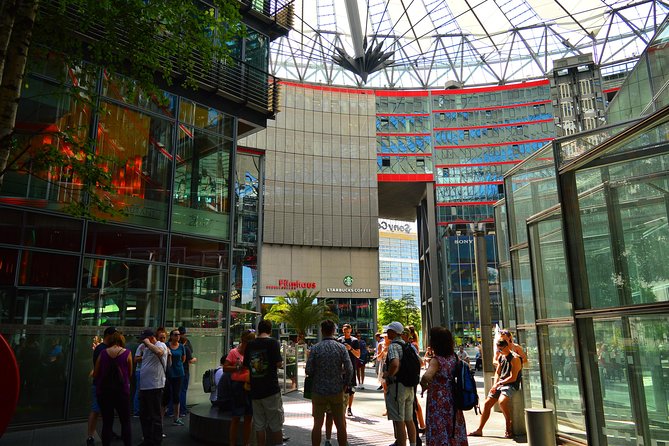
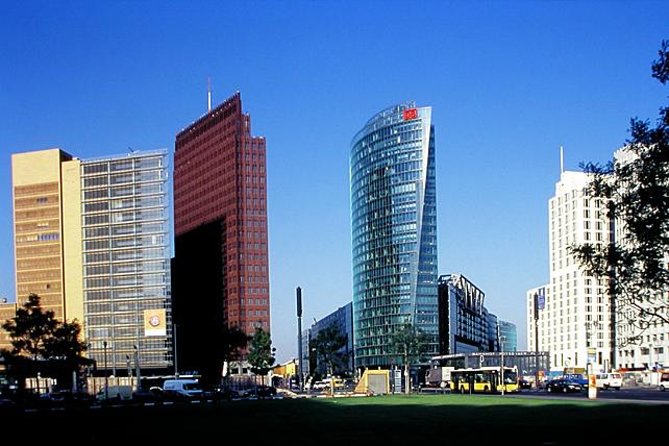
Potsdamer Platz makes Berlin’s changes hard to miss. Once a major city center before World War II, it was badly damaged and later divided by the Wall. Today, large modern buildings and public spaces mark its rebirth as a commercial hub.
The Sony Center’s glass roof is the most recognizable feature, while the DB Tower adds another sleek, glass-clad profile to the area. The square’s modern design contrasts sharply with the historic districts elsewhere on the tour. That contrast is useful: Berlin’s architectural story is not one of simple restoration. Much of the city chose to build anew.
Allow about 20 minutes here. The stop offers a quick overview and a chance to understand the planning choices, rather than time to explore every building or viewpoint.
Kreuzberg and Friedrichshain: neighborhood scale and East Berlin traces
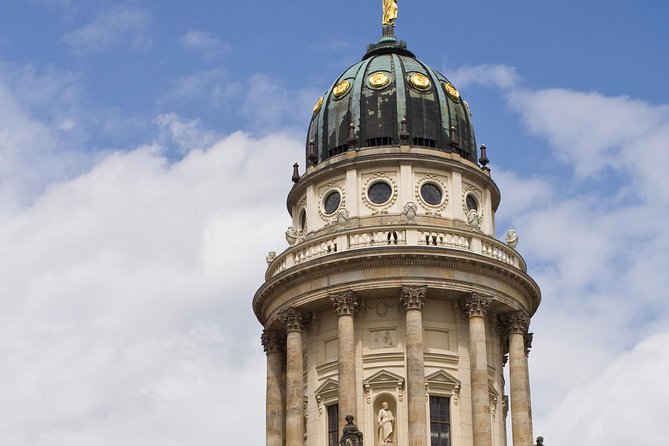
Kreuzberg brings the tour down from grand public buildings to streets shaped by everyday life. Its architecture ranges from 19th-century Altbau apartment blocks, often marked by ornate façades and tall windows, to industrial conversions and newer construction. The neighborhood’s history as a center of alternative culture adds another layer to the buildings you see.
The Oberbaum Bridge is a notable landmark nearby, with red brick towers and Gothic-inspired arches connecting Kreuzberg and Friedrichshain across the Spree. The neighborhood stop is listed at about 30 minutes, which gives the guide room to discuss both the bridge and the surrounding urban fabric.
Friedrichshain offers another East Berlin perspective. Its streets include prewar apartment blocks, socialist-era structures and newer buildings. The East Side Gallery, a painted section of the remaining Berlin Wall, brings political history into the streetscape. It is a useful stop for seeing how a physical remnant of the division has been given a new public meaning.
These neighborhoods are especially valuable if you want more than central monuments. They reveal how architecture meets daily life, and how buildings from different eras now share the same streets. Still, the planned 30 minutes in each area means you should not expect an extended neighborhood walk.
Friedrichstrasse: commerce and urban renewal
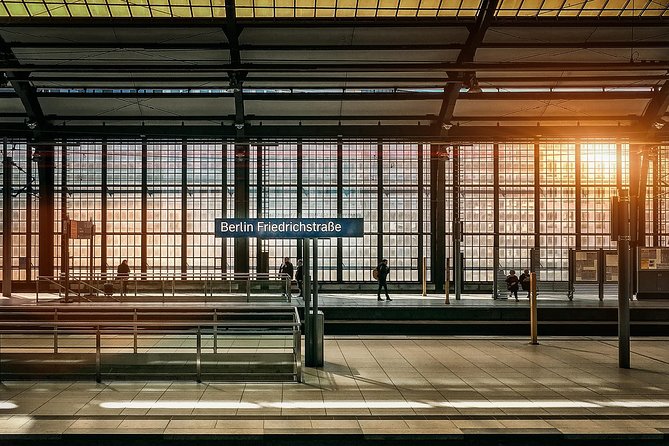
Friedrichstrasse is a major shopping and cultural street that links older Berlin traditions with post-reunification development. The route passes decorated buildings, offices, cafés, restaurants and boutiques, including Galeries Lafayette. Its mix of uses makes it a practical place to talk about urban renewal: how a prominent street can be redeveloped while keeping a sense of its earlier character.
This stop is particularly useful if you are interested in how city planning affects the look and feel of a street, not just individual buildings. Ask your guide to point out what changed and what was preserved. The tour description does not give a separate time allotment for Friedrichstrasse, so its place in the route may depend on your guide’s plan and the time available.
What four hours can realistically cover
The listed route names ten stops, with individual times ranging from 10 to 30 minutes. Those stop times alone add up to several hours, before walking or cycling between locations. The experience is described as customized, so it is sensible to see the route as a menu of possible highlights rather than a promise of a detailed visit at every site.
That flexibility is a real advantage of booking privately. You can choose to focus on Museum Island and central landmarks, or spend more time on the East-West divide and the neighborhoods. One past group took a three-hour version and finished at Museum Island, which shows that the route can be adjusted. It does not mean every booking will follow that same sequence or duration.
At the start, tell your guide which buildings matter most and whether you prefer a brisk overview or fewer stops with more discussion. If you are traveling with someone who is less interested in architecture, the history and political context can keep the tour engaging. Several guides have been praised for making the subject accessible even to people who did not arrive as architecture enthusiasts.
Is $191.87 per person good value?
At $191.87 per person, this is a premium-priced tour. The value depends on how much you want a private guide and how your group uses the time. You are paying for a tailored route, hotel pickup and drop-off, and a guide who can connect architectural details to Berlin’s political and cultural history. A private format also lets you ask questions without keeping pace with a larger group.
The price is harder to justify if you want only a quick photo tour or plan to see the buildings on your own. Many of the stops are public spaces, and food, drinks and attraction admissions are not included. The tour makes most sense if you value expert explanation, want an orientation early in your stay, or have particular architectural interests you would like the guide to address.
Past guests have especially praised guides’ subject knowledge, communication, flexibility and willingness to adjust the route. Sara was described as an architect with a strong grasp of design and history; Thomas, Tom, Daniel, Heiko, Ariel and Tarek were also named for engaging explanations and helpful pacing. You can request a guide, but availability is not guaranteed.
Who should book this private Berlin walk?
I’d consider this tour if you want to understand why Berlin looks the way it does, rather than simply collect landmark photos. It suits architecture fans, design professionals, history-minded visitors and anyone who wants a city orientation with a strong focus on buildings. Families can also make good use of the private format, especially if a teenager has an interest in history or design.
It is less suited to someone who wants museum interiors, long visits at every stop or a low-cost way to get around town. The route spans a lot of ground, and the value comes from the guide’s explanations and your ability to shape the experience. Free cancellation is available up to 24 hours before the start time; changes or cancellations inside that window are not accepted.
If you book, arrive with two or three priorities and tell the guide what you want to understand. That small bit of planning can turn a broad city tour into a much more focused look at Berlin’s architecture and the choices behind it.
FAQ
How long is the Berlin architecture tour?
It lasts about four hours. The route is private and can be customized, so the exact stops and pacing may vary.
Is the tour private?
Yes. Only your group participates.
Where does the tour begin and end?
The guide meets you in your central Berlin hotel lobby, and hotel drop-off is included at the end.
Is the tour offered in English?
Yes. English is the listed language.
Can I take the tour by bike instead of walking?
Yes. You can choose to do the tour on foot or by bike.
Are food, drinks or attraction tickets included?
No. Food and drinks are not included. The tour includes a professional guide and hotel pickup and drop-off.
Newest tours in Berlin
- Berlin: guided canoe | kayaktour★ 4.1 · 7 reviews
- Understanding Kreuzberg: The roots of local (sub)culture★ 4.9 · 11 reviews
- Where It All Began: Berlin’s Queer & Trans History Tour★ 4.9 · 6 reviews
- Warnemünde Shore Excursion: Private Sachsenhausen and Berlin Tour★ 5.0 · 12 reviews
- Ultimate E-Bike Tour of Berlin with Beer Garden Stop★ 5.0 · 4 reviews
- Potsdam Highlights – Private sightseeing tour by minibus★ 5.0 · 3 reviews
- Private Potsdam City Tour in an authentic vintage van★ 5.0 · 14 reviews
- Transfer from Berlin Schönefeld Airport (SXF) to Berlin city Hotels – ROUND TRIP★ 4.0 · 3 reviews
Berlin Walking Tours, compared.

Third Reich Berlin: Hitler and WWII Walking Tour
Read our review →

Explore Berlin: Walking Tour of All The Iconic Sites
Read our review →Browse the lists this tour appears in