
Reviewed · BERLIN WALKING TOURS
Love and War in Berlin: Self-Guided Story Puzzle Walk
Berlin’s past is written into its squares, monuments, and government buildings. On this self-guided puzzle walk, you follow clues from Alexanderplatz toward the Memorial to the Murdered Jews of Europe, passing places tied to Prussian power, Nazi crimes, and the former East German state.
I like two things in particular: the freedom to set your own pace, including taking breaks, and the way the puzzles ask you to look closely at places you might otherwise pass. At $6 per person, it is also an inexpensive way to give a central Berlin walk a clear route and purpose.
The trade-off is that you are on your own. There is no guide to answer questions or add context, and some clues can be exacting. The route also crosses popular central areas, where markets or other events may make you adjust your path.
At a glance: a puzzle walk through central Berlin
- Start at Alexanderplatz: Find the Urania World Clock and begin looking for clues in the square.
- Walk through layers of history: The route includes the Neptune Fountain, Bebelplatz, Gendarmenmarkt, and other central landmarks.
- End near the Holocaust memorial: The stated finish is Cora-Berliner-Straße, close to the Memorial to the Murdered Jews of Europe.
- Play on your schedule: Start when you like, pause when you need to, and resume later.
- Use it offline: The game can be played without an internet connection.
- Expect to solve clues alone: It is a private activity, not a guided tour with a human guide.
From Alexanderplatz, start by looking up
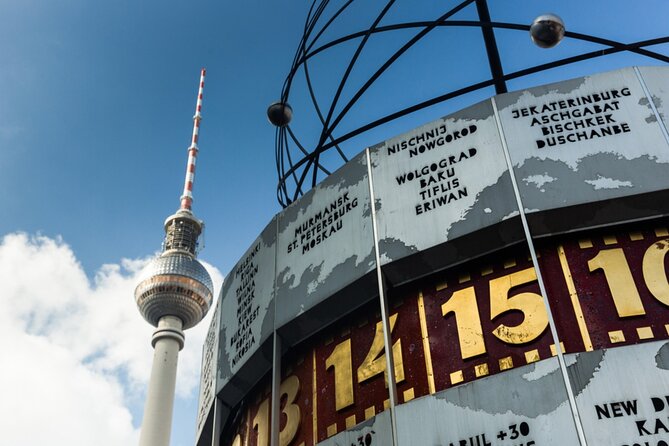
The walk begins at Alexanderplatz, a broad public square in Mitte and one of Berlin’s major central hubs. Your first listed challenge is at the Urania World Clock, a turret-style structure whose markings give the time in 148 cities. It is an apt place to begin: stand still, take in the details, and use what you see to unlock the next location.
The game’s basic rhythm is simple. You reach a site, look around for the answer to a challenge, then follow the instruction to the next place and learn something about it. That gives the walk a little purpose beyond ticking off landmarks. You are not just moving from one famous square to another; you have a reason to notice what is in front of you.
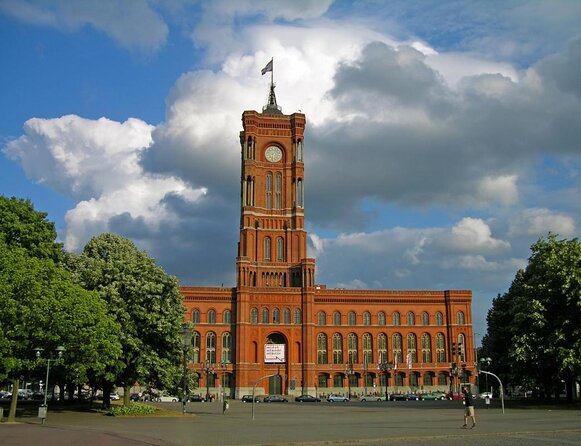
From there, the route includes the Rathaus, Berlin’s red-brick city hall. Built from 1861 to 1869, it blends Northern Italian Renaissance influences with a tower inspired by the cathedral at Laon in France. Even if architecture is not your main interest, it is a good reminder that Berlin’s center has layers older than the twentieth century.
More walking tours in Berlin:
- Discover Berlin Half-Day Walking Tour
★ 5.0 · 9,624 reviews - Berlin: Third Reich and Cold War 2 Hour Walking Tour
★ 4.9 · 6,830 reviews - Berlin: Discover Berlin Walking Tour
★ 4.9 · 5,998 reviews
Neptune Fountain and the city’s changing center
The Neptune Fountain, or Neptunbrunnen, is a natural pause point on the route. Designed by Reinhold Begas and built in 1891, it places the Roman god Neptune at its center. The stop is listed as about ten minutes, which gives you time to inspect the sculpture and solve the challenge without having to rush straight onward.
Nearby, Marx-Engels-Forum introduces a very different chapter. This public park was created by the authorities of the former German Democratic Republic in 1986 and named for Karl Marx and Friedrich Engels. The contrast between the fountain’s nineteenth-century imperial setting and this socialist-era space helps show how Berlin’s public places have been reshaped to reflect changing political priorities.
The route continues to the Lustgarten on Museum Island. Its name means Pleasure Garden, and its uses have changed over time: it has served as a garden, parade ground, site for mass rallies, and public park. That variety makes it a useful stop for thinking about how the same open space can take on different meanings as the city changes.
These are not isolated sights with a single story. They sit within a compact part of Mitte where monuments, civic buildings, and parks reflect successive periods of power. The puzzle format may help you notice the surroundings, but it cannot replace a guide’s fuller explanation. If you want a detailed account of each era, consider pairing this walk with a museum or guided tour.
Bebelplatz and the memory of Nazi book burning
At Bebelplatz, the walk reaches one of its clearest and most sobering historical stops. On the evening of May 10, 1933, Nazi book burnings took place here and in other German university cities. The event was organized by the nationalist German Student Association, which acted ahead of the National Socialist German Students’ League.
The stop is listed for about ten minutes. Take your time with the challenge, but also give the site a quiet moment. The history is not simply a story about books being destroyed; it is a reminder of how public spaces can be used to make persecution visible and political conformity performative.
Nearby, the Neue Wache offers another kind of memorial setting. Karl Friedrich Schinkel designed it as a guardhouse for the Royal Palace, and it was built from 1816 to 1818. It is regarded as a major example of Prussian Neoclassical architecture. Its original purpose connects the building to royal and military authority, while its later use as a memorial gives it a different weight.
The game’s short stops are best treated as prompts, not lectures. If a question leaves you curious, make a note to read more later. That is especially useful at places like Bebelplatz, where a quick clue can point you toward a much larger subject.
Gendarmenmarkt and the route toward government Berlin
Gendarmenmarkt is another major square on the route. Its name comes from the Gens d’armes cuirassier regiment, whose stables once stood here before Friedrich II had them demolished. The square later gained a theatre, now known as the Konzerthaus Berlin, between two churches.
The setting makes this a good place to pause and orient yourself. The square’s name and buildings carry traces of military, civic, and cultural history in one compact space. The challenge gives you a reason to look around rather than simply crossing it on the way to the next stop.
The route then passes the Hamburg state representation on Jägerstraße. This classicist town house is part of the working machinery of modern Germany: Hamburg uses it in Berlin to take part in federal politics and legislation through the Bundesrat. More than 500 events and meetings are held there each year, so the building is not just a historic façade. It remains part of the capital’s day-to-day political life.
That shift from older monuments to an active political address helps the walk connect past and present. Still, this stop may be more interesting if you already have some curiosity about how Germany’s federal system works. The puzzle can direct your attention, but the supplied details do not promise an extended political explanation.
More self-guided options in Berlin:
- Berlin: Solar Powered Sunset Catamaran Cruise & Audio Guide
★ 4.6 · 1,043 reviews - Berlin: Panoramic Boat Tour with Bilingual Audio Guide
★ 4.1 · 136 reviews - Berlin: Self-Guided Family and School Class Scavenger Hunt
★ 4.6 · 128 reviews - Berlin: Scavenger Hunt Self-Guided Tour
★ 4.6 · 79 reviews
The final stretch and the former bunker site
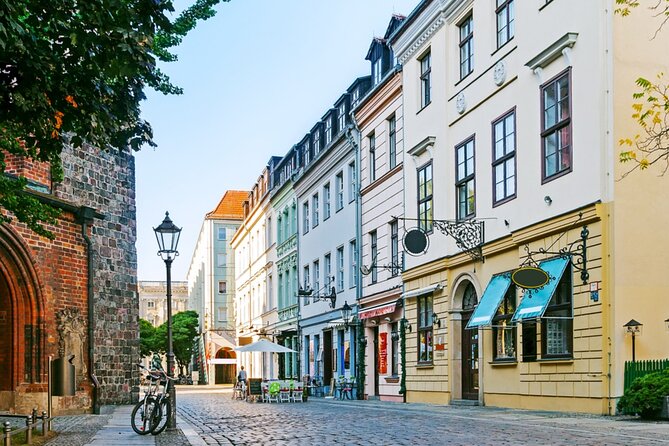
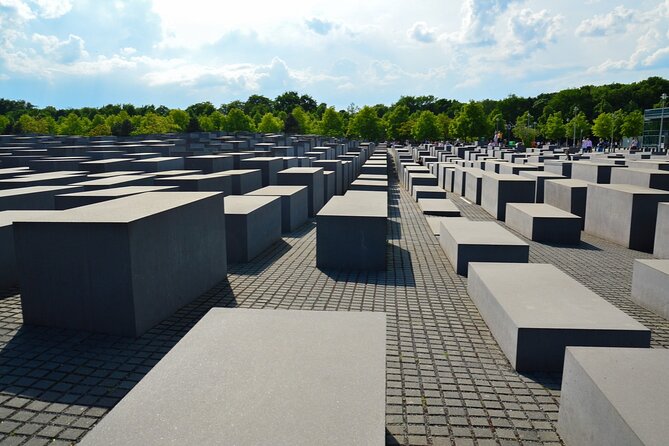
The stated endpoint is Cora-Berliner-Straße, beside the Memorial to the Murdered Jews of Europe. Germany’s parliament approved a central memorial in 1999 after lengthy debate. Architect Peter Eisenman won the design competition, and the memorial opened in 2005. It is a serious place to finish a walk that moves through several periods of German history.
The experience also identifies the site of Hitler’s former war bunker as a highlight. The supplied stop descriptions do not name a separate bunker stop, so check the game’s directions as you approach the final section rather than assuming the memorial and bunker site are the same location. This distinction matters: the memorial commemorates the murdered Jews of Europe, while the bunker site belongs to a different, specific part of the Nazi story.
Give yourself time at the end. The walk is advertised as about an hour, but that estimate leaves little room for lingering at every stop, reading extra background, or taking a break. Since you can pause and resume, there is no need to force the final stretch into a strict timetable.
What the puzzles add, and where they can frustrate
The puzzles are the tour’s main difference from a standard walking route. At each stop, you look for an answer that advances you to the next location. This simple task can make a familiar square feel more engaging, particularly if you are walking with a companion or older children who enjoy solving clues.
The difficulty is not perfectly even. Some questions may feel easy, while others can be hard to settle. A clue may require a very precise answer, so take time to inspect the site and enter the response carefully. If you get stuck, the challenge is part of the format; there is no guide beside you to clarify what the question means.
The route can also need minor adjustments when public events take over a square. Christmas markets, for example, can interrupt a direct path and call for a detour. That is a manageable issue for a flexible walk, but it is another reason not to treat the one-hour estimate as a promise.
Is $6 a good value?
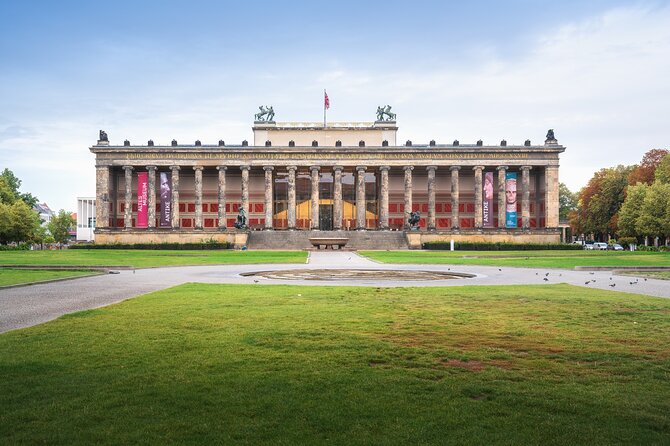
At $6 per person, this is a low-cost way to explore a stretch of central Berlin with a clear route and an activity built in. The price covers the self-guided game, not a human guide, so compare it with what you want: if you mainly need a route and a playful way to pay attention, the cost is appealing. If you want a live expert to answer questions or explain the historical context in depth, this will not fill that role.
The private format can suit a couple, family, or small group that prefers to explore without joining a scheduled tour. Group discounts are available, though the amount is not specified. The game works offline, which is practical if you do not want to rely on a mobile connection as you walk.
You can start at any hour according to the activity details, and the listed opening hours are 5:00 a.m. to 9:00 p.m. It is also described as available to book every day. The start is Alexanderplatz 1, and the finish is Cora-Berliner-Straße 1. Both are in central Berlin, and the activity is noted as being near public transportation.
The booking includes free cancellation if you cancel at least 24 hours before the start time. Changes or cancellations inside that window are not accepted for a refund. Service animals are allowed, and the activity notes that most people can participate.
Who should choose this Berlin walk?
I would choose this walk if you like exploring at your own pace, enjoy solving small challenges, and want to connect central landmarks with snippets of history. It can also work well for someone who has already spent time in Berlin: the route gives familiar places a fresh purpose, and the clue-based format may draw your eye to details you have missed.
It is less suitable if you want a continuous, expert-led explanation of the city’s past. The route touches on major events, but the self-guided format means you decide how much time to spend learning beyond each prompt. Some questions may be exact, and temporary events can get in the way of the planned path.
Book it for a flexible, inexpensive walk with puzzles and historical stops. Skip it if a live guide, deeper commentary, or a tightly managed itinerary is important to you. For the best balance, leave room to linger at Bebelplatz and the Holocaust memorial, and treat the one-hour estimate as a starting point rather than a deadline.
FAQ
How long does the walk take?
It takes about one hour. You can take breaks and resume later, so the total time depends on your pace and how long you spend at each stop.
Where does the tour start and end?
It starts at Alexanderplatz 1, 10178 Berlin, and ends at Cora-Berliner-Straße 1, 10117 Berlin.
Is this a guided tour?
No. It is a self-guided activity, and no physical tour guide is included.
Can I play without an internet connection?
Yes. The game can be played offline.
What is the price?
The listed price is $6 per person. Group discounts are available, but the discount amount is not specified.
What are the listed operating hours?
The listed hours are 5:00 a.m. to 9:00 p.m., Monday through Sunday. The activity is also described as available to book every day.
Can I cancel for a refund?
Yes, if you cancel at least 24 hours before the experience’s start time. Cancellations or changes made less than 24 hours before the start time are not accepted for a refund.
Newest tours in Berlin
- Berlin: guided canoe | kayaktour★ 4.1 · 7 reviews
- Understanding Kreuzberg: The roots of local (sub)culture★ 4.9 · 11 reviews
- Where It All Began: Berlin’s Queer & Trans History Tour★ 4.9 · 6 reviews
- Warnemünde Shore Excursion: Private Sachsenhausen and Berlin Tour★ 5.0 · 12 reviews
- Ultimate E-Bike Tour of Berlin with Beer Garden Stop★ 5.0 · 4 reviews
- Potsdam Highlights – Private sightseeing tour by minibus★ 5.0 · 3 reviews
- Private Potsdam City Tour in an authentic vintage van★ 5.0 · 14 reviews
- Transfer from Berlin Schönefeld Airport (SXF) to Berlin city Hotels – ROUND TRIP★ 4.0 · 3 reviews
Berlin Walking Tours, compared.
Third Reich Berlin: Hitler and WWII Walking Tour
Read our review →

Explore Berlin: Walking Tour of All The Iconic Sites
Read our review →Browse the lists this tour appears in