
Reviewed · BERLIN TOURS
Historical city tour in the African Quarter in Berlin
Berlin’s African Quarter turns street signs into questions about power, memory, and who gets named in public space. On this two-hour walk, you follow that thread from Swakopmunder Straße to Kongostraße, with a map showing Africa before and after the 1884 Berlin Conference.
I like the tour’s focus on a part of German history that often gets less attention, and its change of perspective on familiar ideas of monuments and commemoration. I also like that the group is capped at 20, which can make a guided discussion easier to follow. One consideration: the published stop descriptions are brief, so the depth of the experience depends on the guide’s explanations along the way.
Key points
- A 22-street area monument: The African Quarter’s street names refer to African countries, European cities, and figures connected with Germany’s colonial era.
- A route from Namibia to the Congo Conference: Stops connect Swakopmund and German involvement in Namibia with the 1884 conference in Berlin.
- Street names prompt discussion: Anna-Mungunda-Allee raises questions about the former name Petersallee and why a renaming matters.
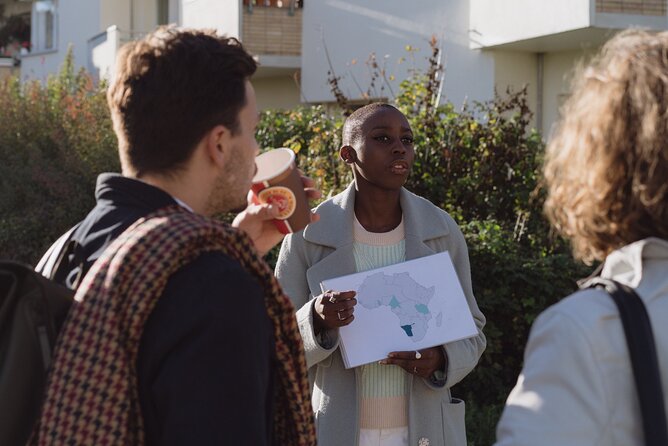
- A map brings the conference into view: At Kongostraße, the guide shows Africa before and after the Berlin Conference.
- Two hours, no more than 20 people: The walk starts at Swakopmunder Str. 44 and ends in the Rehberge area.
- A focused history tour: At $33.57 per person, it suits you best if you want context and discussion, not a broad survey of Berlin.
Why Berlin’s African Quarter deserves a closer look
Berlin’s African Quarter is an area monument made up of 22 streets. Their names refer to African countries, European cities, and people associated with the imperial colonial period. That mix is the heart of the tour: instead of treating street names as background, the guide uses them to ask how Germany’s relationship with Africa was shaped and remembered.
The subject is not simply a list of old names. The walk invites you to consider what those names signal, whose histories they foreground, and what changes when a street is renamed. That makes the experience useful even if you already know a little about German colonial history. You’ll be asked to look at public space as something that reflects choices, not just a map.
The tour focuses on Germany’s colonial period and its ties to African countries, including Namibia. The supplied description calls this a part of German-African history that is rarely discussed. That is a reasonable reason to choose the walk: it gives two hours to a subject that can otherwise be squeezed into a few lines in a broader history tour.
The approach is also deliberately a change of perspective. Expect questions as well as explanations. Who was a street named after? Why was a square named for a particular figure? Should a street’s name change? The tour’s value lies in connecting those questions to the wider story, rather than treating each sign as an isolated curiosity.
More history tours in Berlin:
- Berlin: Natural History Museum Entrance Ticket
★ 4.6 · 3,382 reviews - Berlin: World Heritage Cruise to Potsdam
★ 4.5 · 1,435 reviews - Berlin Historical Highlights Walking Tour
★ 4.9 · 657 reviews
Swakopmunder Straße: Berlin’s link to Namibia
The walk begins at Swakopmunder Str. 44. The opening stop asks what Swakopmund has to do with Berlin and what role Germany played in Namibia. Those questions give the tour a concrete entry point: a name you can see on a street sign becomes a route into a history that extends well beyond the neighborhood.
The listed stop is five minutes, so think of it as a brief anchor rather than a full lesson on Namibia. The larger value comes from how the guide connects the name to German colonial rule and to the other places on the route. If you want a detailed history of Namibia on its own, this tour may not have time for that. If you want to understand why Namibia appears in this Berlin neighborhood, it offers a direct starting point.
This is also a useful moment to settle into the format. You are walking through a residential quarter, not moving between major indoor exhibits. The street itself and its name are part of the material. Keep your attention on the words around you, and be ready to follow the guide’s explanation from a local detail to a wider historical question.
Anna-Mungunda-Allee: when a street name changes
At Anna-Mungunda-Allee, the conversation turns to Petersallee. The guide asks who Petersallee was named after and whether the street should be renamed, and why. That framing gives the stop its force: it asks you to think about the purpose of public commemoration, not simply to memorize a former name.
A renaming can change what a place honors, while the old name remains part of the neighborhood’s story. This stop lets you consider both parts of that process. The street name is evidence of an earlier choice; the current name prompts questions about how that choice is reassessed. The tour does not need to settle every debate for the discussion to be worthwhile.
The provided information does not explain Anna Mungunda’s background, so you should not expect a particular biographical account based on the stop description alone. What is clear is that the stop centers on the naming debate and the colonial history behind Petersallee. If that issue matters to you, listen for how the guide connects the old and new names to the wider theme of memory.
Manga-Bell-Platz: a square named for a colonial-era figure
Manga-Bell-Platz brings the focus to Gustav Nachtigal. The guide addresses who he was and why the central square of the African Quarter was named after him. The description identifies him within the tour’s discussion of the colonial era, but does not provide further biographical details in advance.
The stop is useful because it puts the question of commemoration in a public setting. A square’s name can feel like a settled fact until someone asks why it was chosen. Here, the name becomes a prompt to examine how colonial-era figures were honored and how that legacy is viewed today.
The listed stop lasts five minutes. That is enough to introduce the question, but the explanation and discussion matter. If you are hoping for a detailed biography of Nachtigal, this may not be the right format on its own. If you want to understand why his name appears in the African Quarter and how that fits the tour’s larger story, it belongs on the route.
More city tours in Berlin:
- Berlin: 1-Hour City Tour by Boat with Guaranteed Seating
★ 4.3 · 16,993 reviews - Berlin: City Sightseeing Hop-On Hop-Off Bus Tour
★ 4.1 · 4,233 reviews - Potsdam: City and Castles Tour
★ 4.7 · 3,721 reviews - Berlin: 1-Hour City Sightseeing Cruise
★ 4.4 · 2,210 reviews
Kongostraße: the 1884 Berlin Conference in context
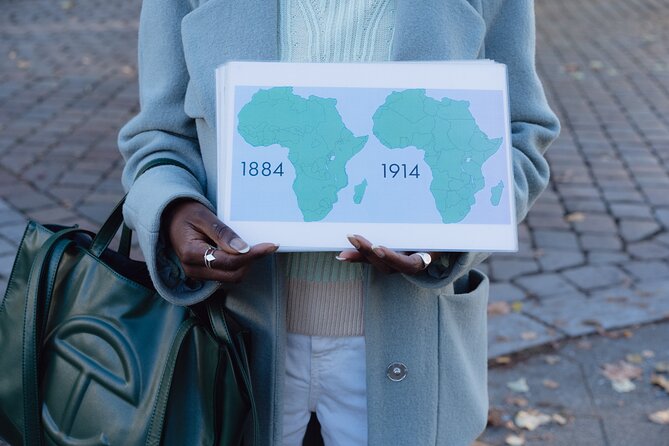
At Kongostraße, the tour turns to 1884 and the Congo Conference, also known as the Berlin Conference. One of the questions is why no one from Africa was present. The guide also shows a map of Africa from before and after the conference, giving you a visual way to consider the changes discussed at this stop.
That map is a practical feature, not just an illustration. A topic as large as the conference can feel abstract when it is described in words alone. Comparing the two maps helps connect a meeting held in Berlin with the wider changes to the continent that the tour asks you to consider. The stop links the neighborhood’s name to a major episode in European colonial history.
The five-minute listing is brief, so you should treat the map as a starting point for understanding rather than a complete account of the conference. Still, this is one of the route’s clearest connections between a Berlin street and the broader history of European power in Africa. It also brings the tour’s central question into sharp focus: who had a voice in decisions that affected the continent?
What the two-hour walk is like
The advertised duration is about two hours, and the group can have no more than 20 people. That is a sensible size for a walk built around explanation and questions. It is small enough to keep the group together, though it is still a group tour, not a private conversation.
The four named stops each have a five-minute duration in the schedule. Those short entries do not mean the whole experience lasts only 20 minutes. The tour is listed as two hours, leaving time for walking between points and for the guide to connect them. The exact pace and amount of discussion are not specified, so don’t plan on a fixed level of detail at every stop.
The start is Swakopmunder Str. 44, 13351 Berlin, and the end is given as Rehberge, 13349 Berlin. The experience is near public transportation, which helps with planning your arrival and onward travel. The ticket is mobile, and confirmation is provided at booking. No guide name is supplied, so you cannot choose a particular guide in advance based on the available details.
The tour requires good weather and a minimum number of participants. If bad weather cancels it, you are offered another date or a full refund. If the minimum group size is not met, you are offered another date or experience, or a full refund. Service animals are allowed, and the activity information says most people can participate.
Is $33.57 good value?
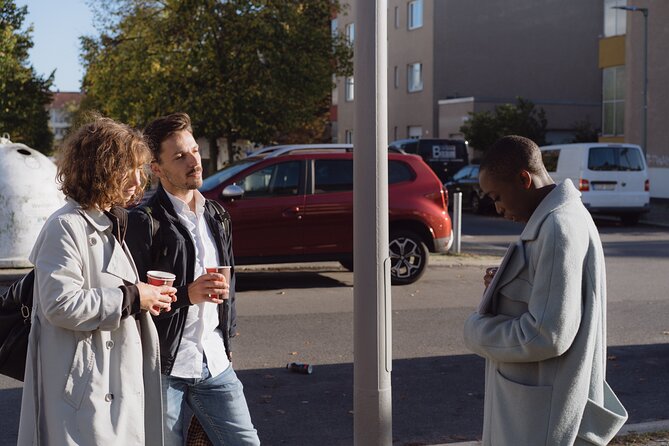
At $33.57 per person for roughly two hours, this is a specialist walking tour rather than a general introduction to Berlin. The price makes most sense if you care about colonial history, public memory, and the stories hidden in street names. You’re paying for a guided thread through the quarter, including a discussion of Namibia, colonial-era figures, and the Berlin Conference, rather than for admission to a series of attractions.
The guide is central to the value. The strongest praise for the experience has focused on an engaging delivery and a strong command of the subject. That matters on a tour where the stops are street corners and signs: a clear explanation can turn a short pause into a useful lesson. Still, the publicly available rating is 3.7 out of 5 from six reviews, a small sample that offers limited certainty about how every tour will go.
The tour is booked, on average, 21 days ahead. That is a booking pattern, not a rule, but it suggests you may want to reserve early if your Berlin dates are fixed. Free cancellation is available up to 24 hours before the start time. After that, the payment is not refunded, and changes made within 24 hours are not accepted.
Who should take this tour?
Choose this walk if you want to look beyond Berlin’s best-known historical sites and spend time with the city’s colonial past. It fits visitors who like to ask how history appears in ordinary places, and who are comfortable with a tour that uses discussion and questions to frame its subject.
It may be less suitable if you want a broad city overview, a museum visit, or a full account of every person named along the route. The supplied information focuses on four stops and a handful of key questions, not a complete survey of German colonial history. You can still get useful context in two hours, but the experience is focused by design.
I’d book it if the relationship between street names and historical memory interests you. The Namibia stop and the map at Kongostraße give the tour clear historical anchors, while the renaming question at Anna-Mungunda-Allee brings the subject into the present. If those themes sound compelling, this is a purposeful way to spend part of a Berlin day.
FAQ
How long is the tour?
It lasts approximately two hours.
What is the price?
The listed price is $33.57 per person.
Where does the tour start and end?
It starts at Swakopmunder Str. 44, 13351 Berlin, Germany, and ends in the Rehberge area at 13349 Berlin.
What are the main stops?
The named stops are Swakopmunder Straße, Anna-Mungunda-Allee, Manga-Bell-Platz, and Kongostraße.
How large can the group be?
The maximum group size is 20 people.
Is the tour available in bad weather?
The experience requires good weather. If it is canceled because of poor weather, you are offered another date or a full refund.
Can I cancel for a refund?
You can cancel for a full refund up to 24 hours before the start time. Cancellations made less than 24 hours before the tour are not refunded.
Newest tours in Berlin
- Berlin: guided canoe | kayaktour★ 4.1 · 7 reviews
- Understanding Kreuzberg: The roots of local (sub)culture★ 4.9 · 11 reviews
- Where It All Began: Berlin’s Queer & Trans History Tour★ 4.9 · 6 reviews
- Warnemünde Shore Excursion: Private Sachsenhausen and Berlin Tour★ 5.0 · 12 reviews
- Ultimate E-Bike Tour of Berlin with Beer Garden Stop★ 5.0 · 4 reviews
- Potsdam Highlights – Private sightseeing tour by minibus★ 5.0 · 3 reviews
- Private Potsdam City Tour in an authentic vintage van★ 5.0 · 14 reviews
- Transfer from Berlin Schönefeld Airport (SXF) to Berlin city Hotels – ROUND TRIP★ 4.0 · 3 reviews
Berlin Tours, compared.
Reichstag, Dome and Government District Guided Tour
Read our review →
1-Hour City Tour by Boat with Guaranteed Seating
Read our review →
Reichstag, Plenary Chamber, Cupola & Government Tour
Read our review →
Browse the lists this tour appears in