
Reviewed · BERLIN TOURS
Night magic city tour in Berlin
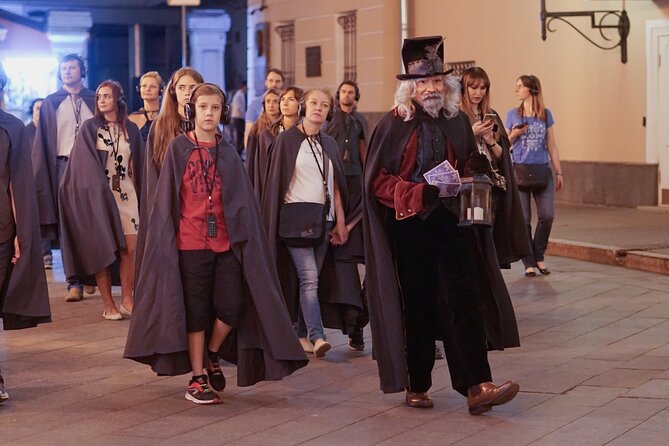
Berlin’s old center is full of stories, but a standard history walk can leave you staring at façades while traffic roars by. This 90-minute night tour takes a more theatrical route, using audio, actors, visual effects, and audience participation to bring the city’s past into the streets. I like that it pairs this playful approach with real historical sites, and that the small group limit of 20 should make it easier to follow along.
I also like the route’s focus on the Nikolaiviertel and the Spree, where Berlin’s beginnings are easier to picture than among the grander avenues. One consideration: this is a performance-led experience, not a conventional lecture, and a guide no-show has been reported. The tour also depends on suitable weather, so leave room in your plans for a possible change of date or refund.
- The Neptune Fountain turns four old Prussian rivers into sculpted figures, each with its own symbolic objects.
- The Nikolaiviertel offers a compact look at Berlin’s reconstructed historic core, close to Alexanderplatz.
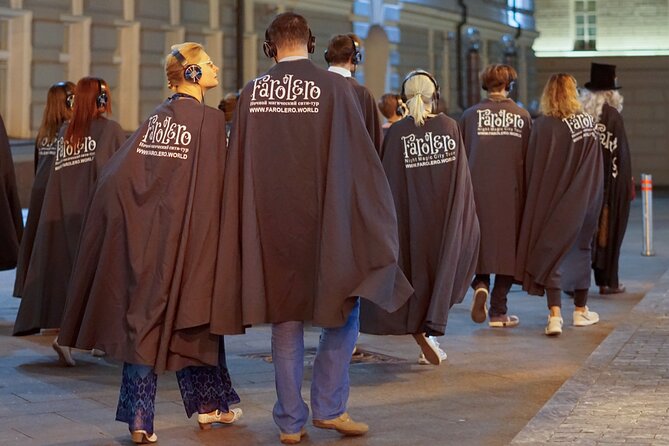
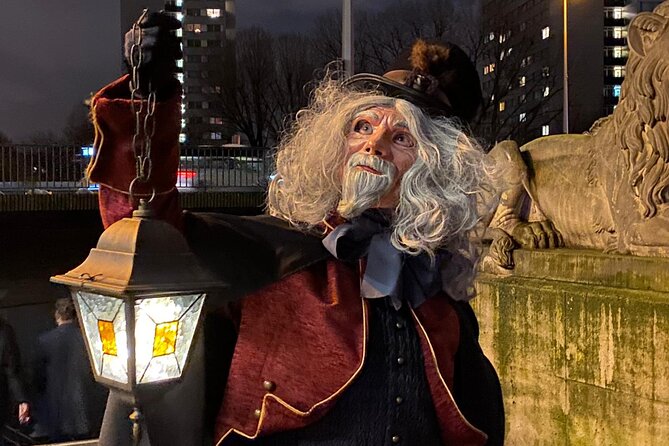
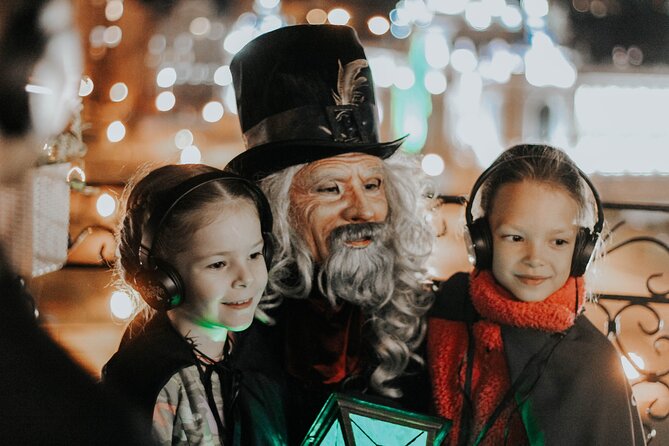
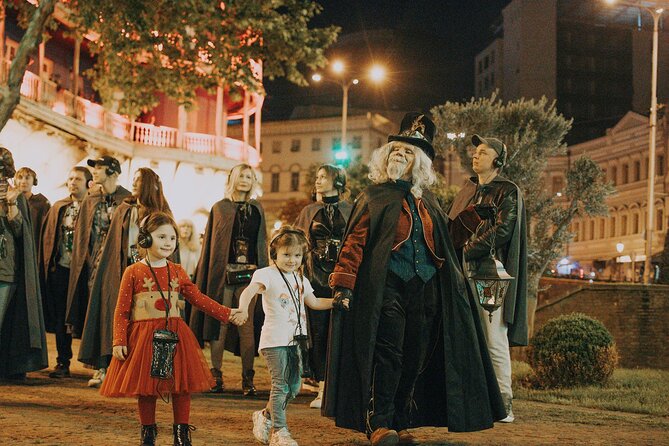
- The tour is theatrical: audio, actors, visual effects, costumes, and audience participation are part of the experience.
- The group is limited to 20, with English offered and mobile tickets accepted.
- The walk takes about 90 minutes, starting at St. Marienkirche and ending near Ephraim’s Palace.
- Plan ahead: the average booking lead time is 53 days, and poor weather or a missed minimum group size can affect the departure.
A Night Walk With a Story to Follow
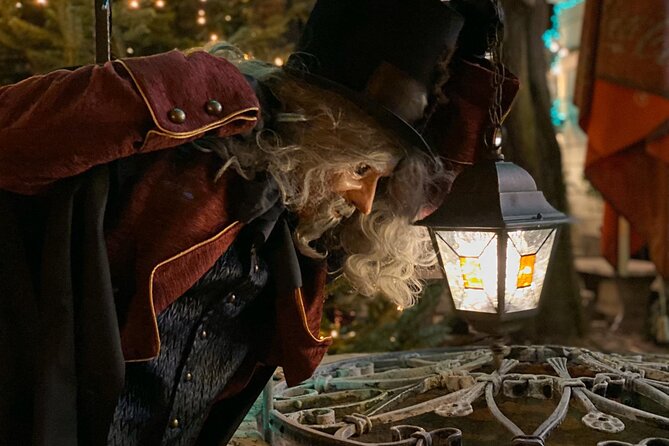
The appeal here is not simply seeing central Berlin after dark. It is the way the tour uses performance to give a walking route a plot. Audio and visual effects help set the scene, while actors and small interactive moments bring the history into the present. One account of the experience also describes participants being given costumes, with coffee, chocolate, and a schnapps served along the way or at the end. Those extras may not be part of every departure, so I would treat them as possible touches rather than guaranteed inclusions.
That theatrical approach suits a city whose past can feel like a stack of dates and political changes. Berlin’s center has been shaped by medieval trade, Prussian rule, division, and reunification. A little role-play can make those shifts easier to remember than a string of facts alone. If you prefer a quiet, lecture-style walk, though, this may feel too staged. The format asks you to take part, not just listen.
The listed duration is about an hour and a half, which makes this an easy evening addition rather than a full-night commitment. The group cap of 20 is also useful: it is small enough to keep a shared activity from becoming a crowd, though it is not a private tour. English is offered, and the ticket is mobile, so you can keep your booking on your phone.
Starting at St. Marienkirche

The meeting point is St. Marienkirche at Karl-Liebknecht-Str. 8, in central Berlin. The church itself helps set the tone: this is a part of the city where old landmarks sit close to modern streets and everyday traffic. The tour ends nearby, at Ephraim’s Palace on Spreeufer, so you finish in the historic center rather than being dropped far from the route.
Do check the exact meeting details before setting out. One account describes a guide not arriving at the appointed time and place, a serious problem on a cold evening with icy pavements. That appears to be an exception, but it is worth keeping the provider’s contact details handy and arriving with enough time to confirm you are in the right spot. This is especially sensible if you have a tight schedule or are unfamiliar with the area.
More evening outings in Berlin:
- Berlin: Solar Powered Sunset Catamaran Cruise & Audio Guide
★ 4.6 · 1,043 reviews - Berlin: Live-Guided Evening Sightseeing Tour by Open-top Bus
★ 4.1 · 783 reviews - Berlin: Bus Tour by Night with Live Commentary
★ 4.2 · 687 reviews
The Neptune Fountain and Its River Figures
The Neptune Fountain, built in 1891 and designed by Reinhold Begas, gives the route a striking point of entry. Roman god Neptune occupies the center, surrounded by four women representing the major rivers of Prussia at the time: the Elbe, Rhine, Vistula, and Oder. The figures carry objects that turn geography into a visual puzzle.
The Elbe figure holds fruit and ears of corn; the Rhine is linked with a fishnet and grapes. The Vistula carries wooden blocks, a nod to forestry, while the Oder is associated with goats and animal skins. These details are the sort of thing that can be easy to miss if you only glance at a fountain on your way past. They also give the guide a chance to connect Berlin’s monuments with a map of a much larger, changing region.
The borders have changed since the fountain was built. The Vistula now lies entirely in Poland, while the Oder forms part of the border between Germany and Poland. That makes the sculpture more than decorative city furniture: it preserves a political geography that no longer exists. I would give yourself a moment to look closely at the figures, even if the tour’s theatrical pace keeps moving.
Red City Hall and the Traffic-Light Man
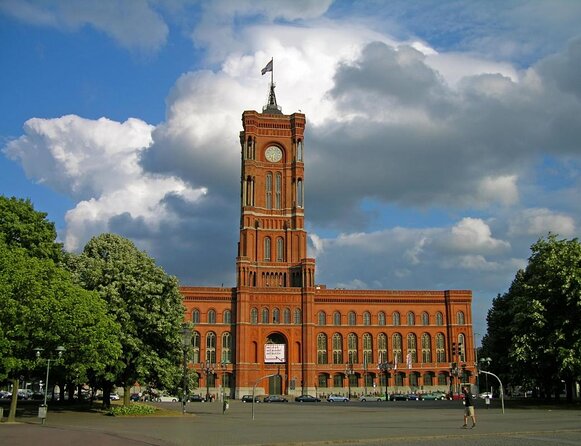
Rotes Rathaus, or Red City Hall, is hard to mistake. Its name comes from the red clinker bricks of its façade, and the building remains the seat of Berlin’s governing mayor and Senate. From the street, you get a useful reminder that this historic-looking center is also a working civic district, not just a preserved old town.
The Ampelmännchen adds a lighter note to the city’s political story. The little traffic-light man appeared in different forms in East and West Germany before reunification in 1990. West German signals used a more generic human figure, while the East German figure was a recognizably male character wearing a hat. It is a small detail, but an unusually memorable one: a symbol from daily street life that still carries the mark of a divided country.
This pairing works well on a short tour. The town hall points to Berlin’s present-day government, while the traffic signal recalls the two German states. Neither needs a long stop to make its point, and together they give the route a change of pace between older monuments.
Finding Berlin’s Medieval Core in the Nikolaiviertel
Founded around 1200, the Nikolaiviertel is part of the reconstructed historic heart of Berlin. Nearby Cölln and Alt-Berlin grew together into the city’s early center, and the quarter sits about five minutes from Alexanderplatz. The lanes and restored buildings offer a more intimate scale than the broad roads and large squares nearby.
There is an important distinction here: this is a reconstructed historic quarter, not an untouched medieval district. Some buildings are restored, and some are modern imitations. That does not make the area worthless. It does mean you should see it as a carefully rebuilt version of Berlin’s old center, shaped by later history as well as its medieval origins.
The theatrical style seems especially suited to these narrower streets. A German-language description of the experience emphasizes historical information delivered with humor and audience involvement, while another notes how audio and visual effects can help screen out traffic noise and other distractions. I like the idea of using the quarter’s atmosphere as a stage, but you should expect an interpretation of history rather than a silent, unmediated encounter with ancient Berlin.
More city tours in Berlin:
- Berlin: 1-Hour City Tour by Boat with Guaranteed Seating
★ 4.3 · 16,993 reviews - Berlin: City Sightseeing Hop-On Hop-Off Bus Tour
★ 4.1 · 4,233 reviews - Potsdam: City and Castles Tour
★ 4.7 · 3,721 reviews - Berlin: 1-Hour City Sightseeing Cruise
★ 4.4 · 2,210 reviews
St. Nikolai-Kirche and the Quarter Around It
St. Nikolai-Kirche is among Berlin’s oldest churches. Construction began between 1220 and 1230, and the church is often described as the oldest in the capital, alongside the nearby Church of Our Lady at Alexanderplatz. Its location anchors the Nikolaiviertel and gives the neighborhood a clear historical center.
The church is part of a wider setting bounded by Spandauer Straße, Rathausstraße, the Spree, and Mühlendamm. That matters because the quarter’s story is not only about one building. Streets, river crossings, and meeting places helped form the early city, and the church gives you a fixed point from which to imagine that older pattern.
The tour’s theatrical elements may make this stop more memorable than a quick exterior look. Still, the information provided does not say that the group goes inside the church, so plan on seeing it as part of the street-level route rather than booking this as a church interior visit. If you want to explore the building in depth, allow separate time for that.
Humboldt Forum: Palace Facades, Modern Museum
The Humboldt Forum stands on Museum Island in Berlin’s historic center. It combines three rebuilt Baroque façades from the former Royal Palace with a contemporary exterior facing the Spree and a modern interior designed by Franco Stella. The result brings together old architectural references and a present-day building, a fitting contrast in a city that has repeatedly rebuilt itself.
The forum is named for Prussian scholars Wilhelm and Alexander von Humboldt. Its role includes housing non-European collections from the Berlin State Museums, along with temporary exhibitions and public events. It is sometimes compared with the British Museum because of its focus on collections from outside Europe, though the tour’s short stop is better for understanding the building and its place in the city than for seeing its exhibitions.
This is a useful stop for anyone interested in how Berlin handles its past. The rebuilt palace façades invite questions about restoration and memory, while the modern river-facing side makes clear that this is not a simple return to the old palace. The tour offers context from the outside; it does not promise museum admission or time to visit the galleries.
Mühlendamm and the Spree Crossing
Mühlendamm is more than a road across the center. It links the historic quarters of Cölln and Fischerinsel with Molkenmarkt in Alt-Berlin, crossing the Spree by the Mühlendammbrücke. The name means Mill Dam and recalls watermills that once stood at this spot.
A causeway was laid here around 1200, making this crossing part of the early city’s development. It helped connect communities on both sides of the river and became a key piece of Berlin’s medieval layout. That is valuable context on a modern street: the route may look like ordinary city infrastructure, but the crossing follows an old line of movement.
The stop also gives the walk a natural connection between the Nikolaiviertel, the river, and the city’s early growth. If you are expecting a scenic river cruise or a long riverside pause, this is not that. The value is in understanding why this particular crossing mattered and how the old center took shape around it.
What the $46.99 Price Buys
At $46.99 per person, this is not the cheapest way to see central Berlin. You are paying for a guided experience with a theatrical layer, not simply access to a set of monuments. The actors, audio, visual effects, and audience participation are the main distinction from a standard walking tour. A small serving of coffee, chocolate, or schnapps may be part of the welcome or finish, but do not count on refreshments as the main value.
The price makes the most sense if you enjoy an imaginative presentation and want a short evening activity that links several sites through one story. It is less compelling if you mainly want a long, detailed history lecture, entry to museums, or free time inside the church. The tour does not list admission to attractions, and its 90-minute length leaves little room for extended visits.
The rating is 4.7 out of 5 from 25 ratings, with 92% recommending the experience. That is encouraging, though 25 ratings are still a modest sample. The isolated no-show report deserves attention alongside the strong overall numbers. I would book with enough schedule flexibility to handle a delay or weather change, rather than placing this right before a nonrefundable dinner or performance.
Who Should Book This Berlin Evening Tour?
This tour should suit you if you like history best when it is acted out, if you want an easy introduction to Berlin’s old center, or if you are traveling with people who might tune out during a traditional lecture. The combination of river landmarks, political symbols, medieval streets, and performance gives the walk several ways to hold your attention.
It may be a weaker fit if you want a conventional walking tour with a named specialist guide, a quiet pace, extensive historical detail at every stop, or guaranteed access to interiors. No guide names are provided, and the tour’s format depends on actors and effects rather than a single lecture-led approach. The walk is offered in English, but the available information does not specify how each audio or performance element is delivered.
The average booking lead time is 53 days, so it is sensible to plan ahead, especially if your dates are fixed. The group is capped at 20, and most people can participate. The experience requires good weather and a minimum number of participants; if it is canceled for either reason, you are offered another date or a full refund. You can cancel for a full refund up to 24 hours before the start time.
Should You Book It?
Book the Night Magic City Tour if you want Berlin’s central history served with a little theater, and if the Nikolaiviertel, the Spree, and the city’s divided past interest you. Its short length and group cap make it an appealing evening option, while the actors and visual effects distinguish it from a standard street walk.
Skip it if your priority is museum entry, a long scholarly talk, or a guaranteed low-key outing. For the price, the performance is the point. Keep your plans flexible, check the meeting place carefully, and arrive ready to join in.
FAQ
How long is the Night Magic City Tour?
The tour lasts approximately 1 hour and 30 minutes.
How much does the tour cost?
The listed price is $46.99 per person.
What language is the tour offered in?
The tour is offered in English.
Where does the tour start?
It starts at St. Marienkirche, Karl-Liebknecht-Str. 8, 10178 Berlin.
Where does the tour end?
It ends at Ephraim’s, Spreeufer 1, 10178 Berlin.
How many people can join the tour?
The maximum group size is 20 travelers.
Can I cancel for a refund?
Yes. You can cancel up to 24 hours before the experience starts for a full refund. Cancellations made less than 24 hours before the start are not refunded.
What happens if bad weather cancels the tour?
If poor weather cancels the experience, you will be offered a different date or a full refund. The same options apply if the minimum number of participants is not met.
Newest tours in Berlin
- Berlin: guided canoe | kayaktour★ 4.1 · 7 reviews
- Understanding Kreuzberg: The roots of local (sub)culture★ 4.9 · 11 reviews
- Where It All Began: Berlin’s Queer & Trans History Tour★ 4.9 · 6 reviews
- Warnemünde Shore Excursion: Private Sachsenhausen and Berlin Tour★ 5.0 · 12 reviews
- Ultimate E-Bike Tour of Berlin with Beer Garden Stop★ 5.0 · 4 reviews
- Private Potsdam City Tour in an authentic vintage van★ 5.0 · 14 reviews
- Transfer from Berlin Schönefeld Airport (SXF) to Berlin city Hotels – ROUND TRIP★ 4.0 · 3 reviews
- Potsdam Highlights – Private sightseeing tour by minibus★ 5.0 · 3 reviews
Berlin Tours, compared.
Reichstag, Dome and Government District Guided Tour
Read our review →
1-Hour City Tour by Boat with Guaranteed Seating
Read our review →
Reichstag, Plenary Chamber, Cupola & Government Tour
Read our review →
Browse the lists this tour appears in