
Reviewed · BERLIN TOURS
Where It All Began: Berlin’s Queer & Trans History Tour
Berlin’s queer history is not tucked away in a museum. It runs through streets once lined with lesbian bars, drag clubs, activist groups, and places of refuge, then through sites tied to Nazi persecution and the AIDS crisis. This tour connects those stories in the neighborhoods where they unfolded.
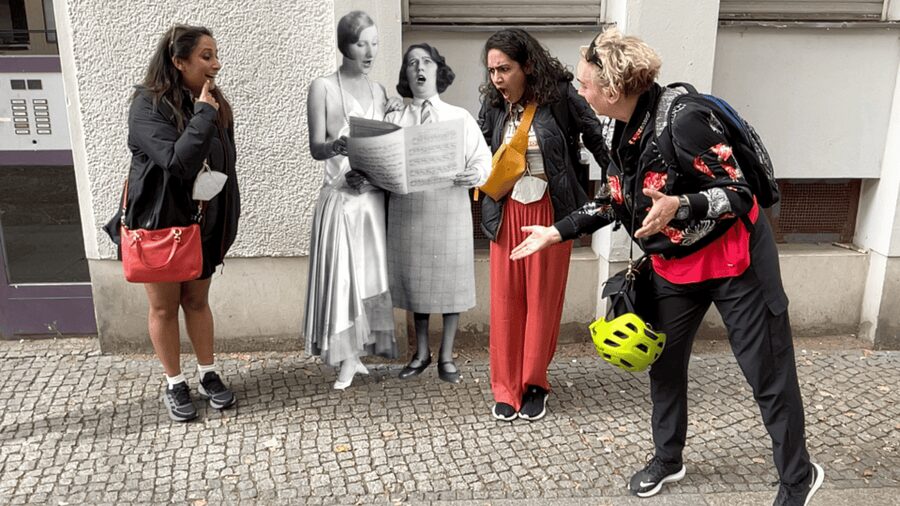
I like two things in particular: the small group of up to 10 gives the guide room to explain difficult history, and the iPad’s archival photos and augmented reality help you compare old images with the streets around you. Guide Jeff has been praised for making the subject lively as well as moving, without losing the detail.
The main consideration is the length. At about three and a half hours, this is a substantial walk, and the tour requires good weather. It is best for you if you want a focused historical experience, not a quick overview of Berlin or a night out.
Key points
- A street-level history lesson: Ten stops link people, places, and movements from the 19th century to present-day queer activism.
- A small group: The tour is capped at 10 people, which can make it easier to follow the stories and ask questions.
- Archival material on the route: The guide uses an iPad, augmented reality, and more than 200 historical photos, videos, and other materials.
- A wide historical range: Expect to cover early rights organizing, Nazi persecution, postwar activism, the AIDS crisis, and nightlife today.
- Practical timing: The tour starts at 2:00 pm, lasts about three and a half hours, and ends at Metropol in Nollendorfplatz.
A Berlin walk that puts queer history on the map
Where It All Began: Berlin’s Queer & Trans History Tour gives you more than a list of historic clubs. It follows the people who made community under changing and often dangerous conditions, from Karl Heinrich Ulrichs and Magnus Hirschfeld to postwar activists and today’s nightlife organizers.
That approach matters in Berlin, where the past is not always easy to see from the pavement. Some venues have changed use or disappeared, and the names on the route may mean little without context. The guide’s images and explanations help connect the present-day locations to their earlier lives.
This is a walking tour with a clear subject, not a general introduction to Berlin. If queer history is central to your visit, the focus is a real strength. If you want broad coverage of the city’s main sights, you will need another tour.
More history tours in Berlin:
- Berlin: Natural History Museum Entrance Ticket
★ 4.6 · 3,382 reviews - Berlin: World Heritage Cruise to Potsdam
★ 4.5 · 1,435 reviews - Berlin Historical Highlights Walking Tour
★ 4.9 · 657 reviews
Karl Heinrich Ulrichs and early rights activism
The route begins with Karl Heinrich Ulrichs, a 19th-century writer and advocate for decriminalizing same-sex relationships. The tour presents him as one of the earliest public voices for gay rights, and explains how he developed ideas about queer identity before the modern term homosexual was in use.
The stop is brief, about five minutes, but it sets up a key theme: Berlin’s queer history did not begin with its famous clubs of the 1920s. It also began with people who argued publicly for recognition and legal change, at a time when even naming these identities was difficult.
Nollendorfplatz and persecution under the Nazis
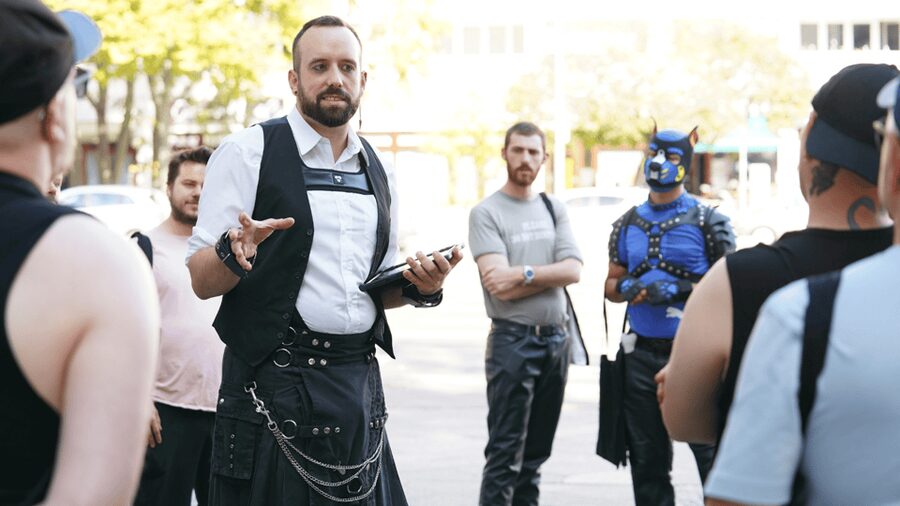
At Nollendorfplatz, the tour turns to a complicated and painful period. You hear about Adolf Brand, the presence of right-wing gay activists, and the contradictory role of Ernst Röhm, an openly gay Nazi leader whose position did not protect him or others from the regime’s violence.
The stop also covers the Night of the Long Knives and the Nazi persecution of LGBTQIA+ people, including imprisonment in concentration camps and the forced use of the pink triangle. The guide frames this not as a simple story of victimhood, but also as one of resistance and survival. Give this section your attention: it is heavy material, and the historical contradictions require care.
Lesbian Berlin, cabaret, and life on Schwerinstraße
At Schwerinstraße 13, the focus shifts to lesbian life in 1920s Berlin. The site of the former Toppkeller offers a way to discuss how bars and social venues gave queer women room to meet and build community, even when public acceptance was limited.
The guide also brings in Claire Waldoff, a lesbian cabaret singer whose songs became associated with defiance, and Josephine Baker, the bisexual performer and international star. This stop helps correct a common imbalance in older accounts of queer history, which often concentrate on gay men and leave women’s lives at the margins.
Same city, a different kind of day:
- Berlin: Reichstag, Dome and Government District Guided Tour
★ 4.7 · 18,288 reviews - Berlin: 1-Hour City Tour by Boat with Guaranteed Seating
★ 4.3 · 16,993 reviews - Berlin: Boat Tour Along the River Spree
★ 4.4 · 11,252 reviews - Discover Berlin Half-Day Walking Tour
★ 5.0 · 9,624 reviews
Isherwood, police surveillance, and the world behind Cabaret
At Nollendorfstraße 17, stories of gay male life in 1920s Berlin meet the less celebratory subject of police scrutiny. The tour discusses the homosexual department of the Berlin police force, a reminder that visibility and nightlife existed alongside efforts to monitor and control queer people.
You also hear about writer Christopher Isherwood, whose experiences in Berlin helped inspire Cabaret, and his relationship with Heinz Neddermeyer. Their escape from Nazi Germany as queer refugees makes this stop more than a literary footnote. It shows how private relationships could become matters of survival when political conditions changed.
Magnus Hirschfeld and the Institute for Sexual Science
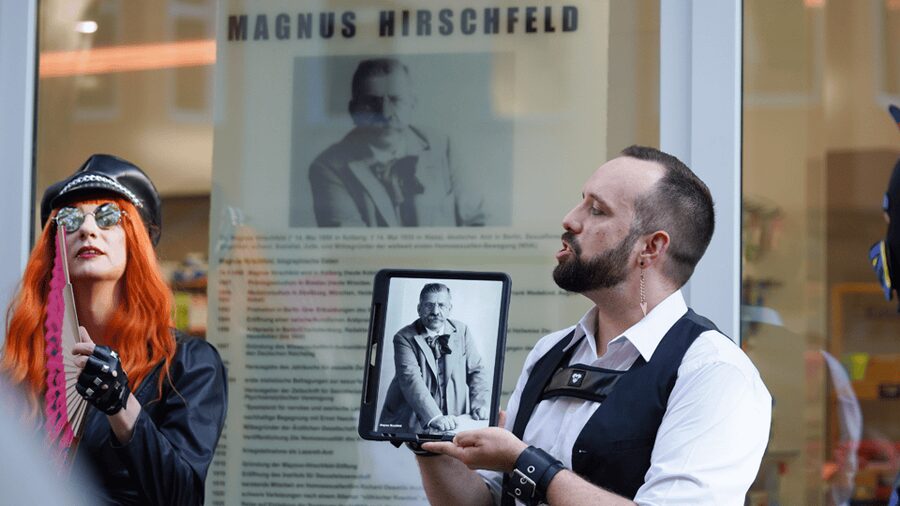
At Magnus-Apotheke, the subject is Magnus Hirschfeld and the early organized fight for queer rights. The guide explains the work of Hirschfeld’s Institute for Sexual Science and the Scientific-Humanitarian Committee, described as the first organization devoted to queer rights and gender studies.
You’ll hear about Hirschfeld’s theories of sexual intermediaries, the idea of a third gender in Berlin, and early gender-affirming surgeries involving Dora Richter, Lili Elbe, and Karl M. Baer. The stop also addresses Paragraph 175, which criminalized homosexuality, and the Nazis’ destruction of the institute. That loss was not only an attack on a community, but a blow to research and records that might have preserved more of its history.
The range here is broad, so the guide’s use of archival images is especially useful. Rather than treating these figures as distant names, the tour connects their work to a real institution and to the legal and social forces that shaped their lives.
Eldorado and Berlin’s drag culture
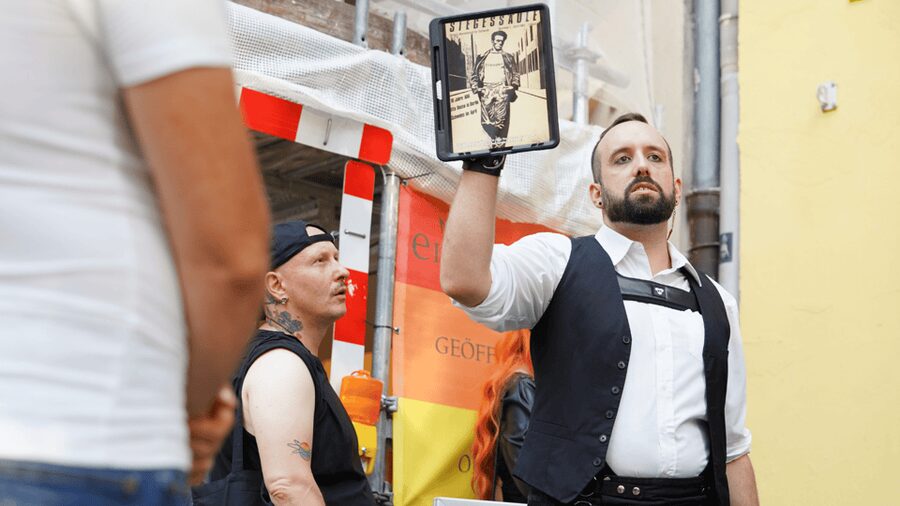
A present-day Denns BioMarkt marks the former site of Eldorado, one of Berlin’s best-known drag bars in the 1920s. The club was a gathering place for gender-nonconforming people and queer performers, and the tour notes that Ernst Röhm also frequented it.
That detail captures one of the tour’s more unsettling themes: people could share social spaces even when their politics and interests were sharply opposed. Eldorado’s history also helps explain why Berlin’s queer nightlife has long been more than entertainment. For many, clubs offered visibility and a chance to find others like themselves.
Postwar organizing and Charlotte von Mahlsdorf
At Prinz Eisenherz, the tour moves into postwar queer activism. You hear about Homosexuelle Aktion West-Berlin, one of the first queer rights organizations after World War II, and SchwuZ, a club that became an important part of Berlin’s queer social life.
The stop also introduces Charlotte von Mahlsdorf, a trans woman who preserved Berlin’s queer history and created safe spaces in East Berlin. Her story adds an important perspective to a tour that might otherwise lean heavily on nightlife and West Berlin. It shows how preserving objects, memories, and meeting places can itself be an act of community work.
Chez Romy Haag and the trans community
At Connection, the subject is West Berlin’s trans community in the 1970s and 1980s. The tour explores Chez Romy Haag, a trans-led nightclub that made space for gender-diverse people and helped shape the city’s later club culture.
This stop’s value lies in the link between a specific venue and a broader change in who could be visible in public life. It is a reminder that today’s reputation for queer nightlife did not appear on its own. People built spaces where they could gather, perform, and live more freely, often before wider society was ready to accept them.
The AIDS crisis in a divided city
At the Internationale Stele GEGEN DAS VERGESSEN, the tour addresses the AIDS crisis and its effects on Berlin while the city was divided. The guide discusses how queer communities organized to protect and support one another, as well as the public role of politician Rita Süssmuth, one of the few politicians advocating for AIDS awareness.
The tour also explains the phrase condom of the GDR, a metaphor for the way the Berlin Wall shaped the East’s and West’s differing responses to the crisis. This is a compact but useful way to connect public health, politics, and the daily realities of a divided city. The subject can be emotionally difficult, but it belongs in any account of modern queer history.
Metropol, pride, and the fight for an affordable city
The final stop is Metropol, at Nollendorfplatz 5. Here the route brings the story into the present, covering the club’s place in early gay community life and the development of Berlin’s techno scene, with links to today’s Berghain and Lab.Oratory.
The closing discussion also ranges beyond clubs. You hear about SO36’s queer nights, Folsom Europe, Kreuzberg Pride, the Dyke March, and the work of the radical Tuntenhaus squat around keeping Berlin affordable. That last topic makes a fitting end: queer history is not only about preserving the past, but also about who can still afford to live and gather in the city.
The tour ends at Metropol, so you finish with a set of names and places to look up if you want to explore Berlin’s queer nightlife further. The guide also shares insider tips on current events and venues, though the tour itself is a history walk, not a bar crawl.
What the format adds, and what it cannot do
The group limit of 10 is a practical advantage. A smaller group is easier to keep together on a city walk, and it gives you a better chance to ask about a person or location that catches your interest. The tour is offered in English and includes a mobile ticket.
The guide uses an iPad to show more than 200 rare historical photos, videos, and archival materials, along with augmented reality features. A feature called Mixies lets you take personalized photos with AR elements. These tools can make vanished venues easier to picture, though they are there to support the history, not replace it.
The route covers ten stops, with planned discussion periods ranging from about five to 20 minutes. The full tour lasts around three and a half hours, so allow time for walking between places and a possible café break. A drink at the café is not included, and the tour requires good weather.
Is $83.13 a fair price?
At $83.13 per person, this costs more than a basic city walk. The value depends on what you want: you are paying for a specialist-led tour, a group capped at 10, and a large collection of archival material used along the route. Across three and a half hours, the listed price works out to about $23.75 per hour.
I see the strongest value in the combination of subject knowledge and place-based context. You could visit Nollendorfplatz, Metropol, or the former Eldorado site on your own, but you would not necessarily know what stood there or how the locations connect to activism, persecution, and social life. The AR material adds another layer, particularly where the old venue is no longer visible.
The tour is not a substitute for a museum visit or a full account of every period in queer history. Ten stops in one afternoon mean some subjects receive only a short introduction. Think of it as a well-focused framework that can help you decide what to explore further.
Who should book this Berlin history walk?
Book it if you want to understand Berlin through LGBTQIA+ lives and movements, and you are comfortable spending most of an afternoon on a guided walk. It suits curious first-time visitors and people who already know the basics but want a closer look at the city’s queer past and present.
It may be less suitable if you prefer a fast-paced sightseeing route, want a broad survey of Berlin, or do not want to spend time on difficult subjects such as Nazi persecution and AIDS. The tour is rated for most participants, but it is still a three-and-a-half-hour outdoor activity. Service animals are allowed, and the meeting point is near public transportation.
The tour starts at 2:00 pm outside Alnatura Super Natur Markt, Else-Lasker-Schüler-Straße 18, and ends at Metropol, Nollendorfplatz 5. It is often booked around 36 days ahead, so plan early if your dates are fixed. You can cancel for a full refund up to 24 hours before the start; poor weather or too few bookings can also lead to a different date or a refund.
Should you book it?
If Berlin’s queer history matters to you, this is a strong choice: small group, focused route, and archival material that helps make the sites legible. I would book it for the stories and context, not for a checklist of landmarks. If you want a lighter or broader introduction to Berlin, choose a general city walk instead and save this one for a visit when you can give the subject a full afternoon.
FAQ
How long is the tour?
It lasts about three hours and 30 minutes.
What time does the tour start?
The start time is 2:00 pm.
Where does the tour begin and end?
It begins at Alnatura Super Natur Markt, Else-Lasker-Schüler-Straße 18, 10783 Berlin, and ends at Metropol, Nollendorfplatz 5, 10777 Berlin.
How large is the group?
The maximum group size is 10 people.
What is included in the price?
The tour includes a guided walk led by a queer activist and gender scholar, augmented reality elements, Mixies photo features, more than 200 archival photos, videos, and other materials, plus tips on modern queer nightlife and events.
Is a café drink included?
No. Coffee or tea during a possible café break is not included.
Can I cancel if my plans change?
You can cancel at least 24 hours before the start time for a full refund. If the tour is canceled because of poor weather or because the minimum number of participants is not met, you will be offered another date or experience, or a full refund.
Newest tours in Berlin
- Berlin: guided canoe | kayaktour★ 4.1 · 7 reviews
- Understanding Kreuzberg: The roots of local (sub)culture★ 4.9 · 11 reviews
- Where It All Began: Berlin’s Queer & Trans History Tour★ 4.9 · 6 reviews
- Warnemünde Shore Excursion: Private Sachsenhausen and Berlin Tour★ 5.0 · 12 reviews
- Ultimate E-Bike Tour of Berlin with Beer Garden Stop★ 5.0 · 4 reviews
- Potsdam Highlights – Private sightseeing tour by minibus★ 5.0 · 3 reviews
- Private Potsdam City Tour in an authentic vintage van★ 5.0 · 14 reviews
- Transfer from Berlin Schönefeld Airport (SXF) to Berlin city Hotels – ROUND TRIP★ 4.0 · 3 reviews
Berlin Tours, compared.
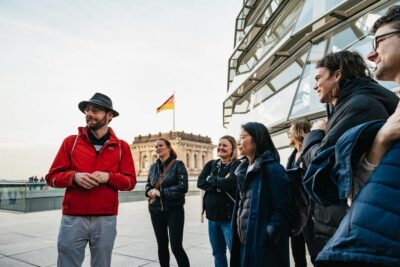
Reichstag, Dome and Government District Guided Tour
Read our review →
1-Hour City Tour by Boat with Guaranteed Seating
Read our review →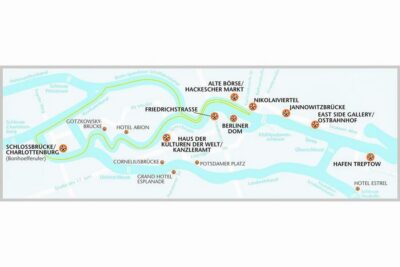
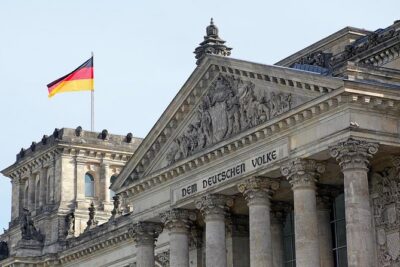
Reichstag, Plenary Chamber, Cupola & Government Tour
Read our review →
Browse the lists this tour appears in