
Reviewed · BERLIN RICKSHAW TOURS
Private Guide Up to Group 6 – ONE Rickshaw, (E)Bikes, E-Scooters
Berlin’s landmarks make more sense when you can connect them in one ride: the royal palace, Cold War checkpoints, Nazi-era sites, and the Brandenburg Gate all sit within a compact sweep of central Berlin. This private three-hour tour covers that ground by rickshaw, bike, e-bike, or e-scooter, with guide Levi sharing stories along the way.
I like two things in particular: you can travel as a group while choosing different vehicles, and the rickshaw offers a low-effort way to get close to monuments if walking is difficult. Levi’s humor and willingness to take questions also give the history a personal, relaxed feel.
One point to check before paying: the vehicle options and fleet numbers are not entirely clear, and the stated meeting point differs from the TV Tower mentioned in the route description. Confirm your vehicle and exact starting place with the operator.
- A private ride for up to six: Your group has the guide to itself, with no unrelated participants.
- Several ways to travel: Options include a rickshaw, regular bikes, e-bikes, and e-scooters, though you should confirm which arrangement is available for your group.
- Berlin’s central history in one route: Stops cover sites from the Prussian era through the Nazi period and Cold War.
- A gentler option for limited mobility: The operator describes the rickshaw as easy to enter in a few steps and says you can get close to monuments without leaving it.
- A guide with a light touch: Levi’s humor, explanations, and time for questions are a key part of the experience.
- Bring your own lunch plan: Bottled water is included, but lunch is not.
Berlin history by rickshaw, bike, or scooter
This is a sightseeing tour with a useful twist: your group can travel by different types of vehicle but stay together, stopping for shared explanations. That makes it less of a standard walking tour and more of a moving introduction to Berlin Mitte. You cover a lot of symbolic ground without having to navigate between sites on your own.
The route links ten stops, from the TV Tower area to the Brandenburg Gate. Most stops are short, typically 10 to 20 minutes, so think of this as a broad overview rather than a deep visit inside museums or memorial buildings. You get a guide’s framing and time to look around, but the schedule does not provide time for extended museum visits.
The experience is private for your group, which matters here. You can ask questions, hear stories at your own pace, and keep the day personal rather than following a large crowd. Levi is named as the guide, and the feedback about his style points to a lively, humorous approach. Dutch has been spoken on tours, but confirm language availability before booking if that is important to you.
Choosing a vehicle that suits your group
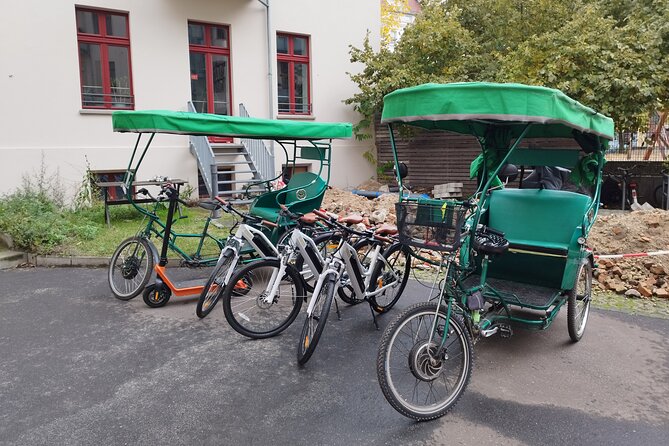
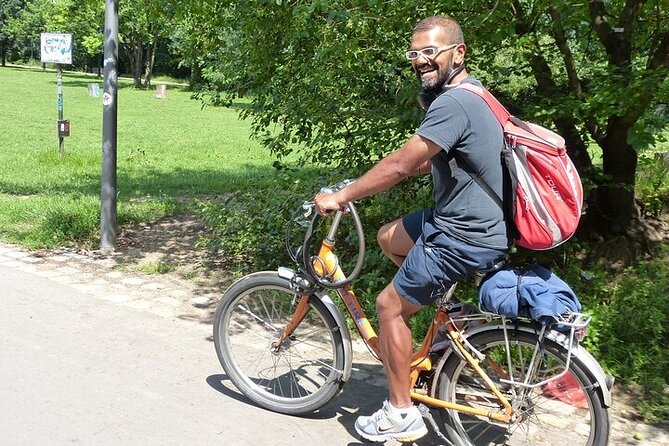
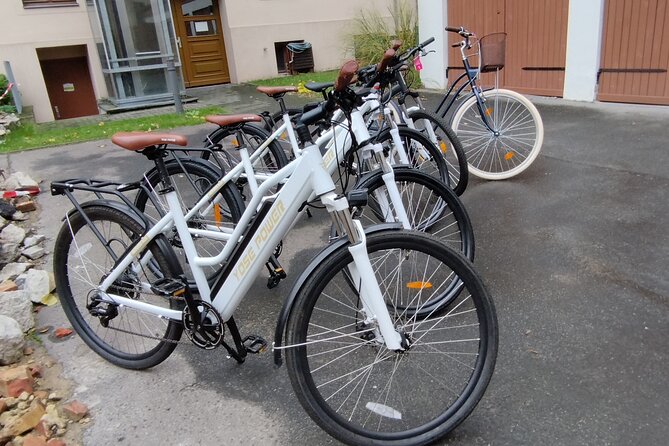
The tour offers regular bikes, e-bikes, e-scooters, and a rickshaw. Its appeal is that you do not all need to travel in the same way: the group can select different vehicles and still stop together. That flexibility may work well for families or mixed-age groups, or for a group where one person would rather not cycle.
The rickshaw is the clearest option for people who have trouble getting around. The operator says it takes only a few steps to get in, and you can come close to monuments without getting out. That can make a central sightseeing route possible for someone who would find a long walk tiring. It is not a substitute for every kind of mobility support, so ask the operator about your specific needs.
There is a small but important uncertainty in the vehicle information. The tour is priced for up to six people, while the included fleet is described as two bikes, three e-bikes, and one rickshaw for up to seven. E-scooters appear among the selectable options, too. The description does not clearly explain how those numbers apply to each booking, so confirm what your group will actually ride before you reserve.
More rickshaw tours in Berlin:
- Berlin: Private Guided E-Rickshaw Tour
★ 4.9 · 157 reviews - Individual City Tour – Rickshaw Sightseeing in Berlin
★ 5.0 · 120 reviews - Berlin Express: Private 1-Hour E-Rickshaw Ride
★ 5.0 · 116 reviews
Starting near the TV Tower
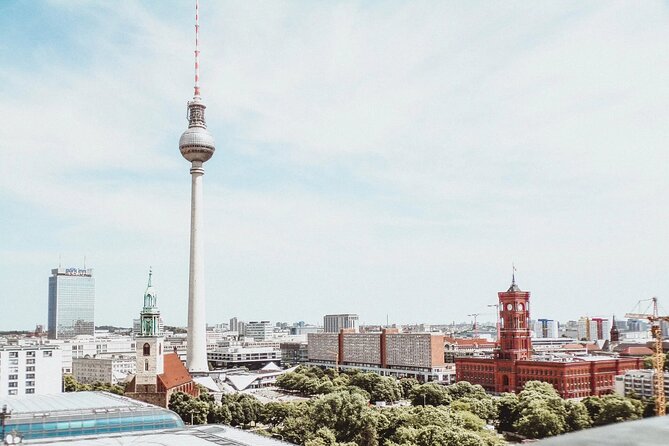
The route description opens at the TV Tower, or Fernsehturm, rising above Alexanderplatz. At about 368 meters, it is one of Berlin’s most recognizable structures. The tour information identifies it as a meeting point example, rather than clearly promising an outside stop or a visit to the observation deck.
That distinction matters if you are hoping to go up the tower. The experience is a street-level ride, and no observation-deck admission is listed. You can still use the tower as a landmark to orient yourself: it signals the former East Berlin center and offers a striking reference point as you head into the historic core.
The confirmed meeting address is Weinbergsweg 6, while the TV Tower is mentioned as an example meeting location. Because those details do not match exactly, check the final meeting instructions with the operator rather than assuming you should wait at Alexanderplatz.
From the Red City Hall to the old palace
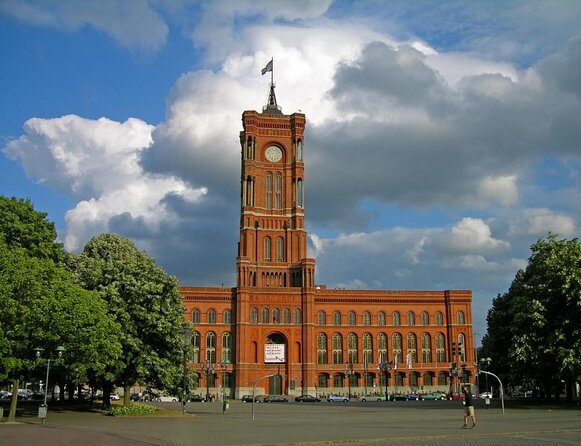
The Rotes Rathaus, or Red City Hall, is a natural place to consider Berlin as a capital still shaped by politics and public life. Its role as the city’s administrative center links the monuments around it to the ongoing work of governing Berlin. The tour description does not give a timed stop here, so treat it as part of the route’s passing context unless your guide confirms otherwise.
At the Stadtschloss, also called the Berlin City Palace, the story shifts to royal Berlin and the city’s changing ideas about its past. The palace began as a residence for the Hohenzollern dynasty, was destroyed during World War II, and later became the subject of debate after reunification. The reconstructed exterior now houses the Humboldt Forum, combining a Baroque-style façade with modern interiors.
The planned 15-minute stop gives you time to take in the building and hear why its reconstruction remains a charged subject. The tour does not include admission, and the schedule does not set aside time to explore the Humboldt Forum’s exhibitions. If you want to go inside, plan another visit.
Museum Island and Unter den Linden
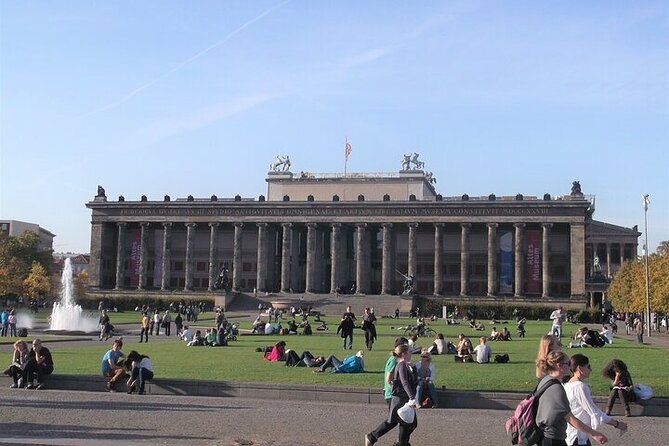
Museum Island brings several major museums and historic collections together on a UNESCO World Heritage site. Even from outside, the cluster makes a strong impression: Berlin’s cultural ambition is written into the scale and arrangement of its museum buildings. The stop is listed as 20 minutes, enough for a look and an explanation, not a full museum visit.
That short pause is useful if this is your first time in Berlin. Your guide can help you place the island within the city’s broader story, while you note which museum you might want to return to. If you already know you want to spend time with the collections, do not count on this ride to replace a separate visit.
From there, Unter den Linden offers a broad view of Berlin’s architectural layers. Baroque, Neoclassical, and modern buildings sit along the boulevard, with landmarks such as the State Library and Kronprinzenpalais along the way. The listed stop is only 10 minutes, so the value is in seeing how these buildings relate to one another, not in entering them.
More scooter rentals in Berlin:
- Berlin: Thrilling E-Scooter Adventure Tour
★ 4.4 · 66 reviews - 2-H Berlin: Top Sights Guided E-Scooter Tour
★ 4.3 · 48 reviews - Berlin: Ultimate E-Scooter Adventure Tour
★ 4.5 · 35 reviews - Berlin: 3-H Top Sights Guided E-Scooter Tour
★ 4.6 · 33 reviews
Bebelplatz and Gendarmenmarkt
Bebelplatz carries one of the route’s most sobering stories. In 1933, books deemed un-German were burned here under the Nazi regime. A glass panel in the square looks down onto empty bookshelves, a spare memorial to censorship and the destruction of ideas.
Ten minutes is a brief stop for such a heavy subject, but the memorial’s design is direct and easy to understand once your guide explains what you are looking at. Give yourself a moment to take it in. The point is not grand spectacle, but the absence made visible beneath the pavement.
Gendarmenmarkt shifts the mood to one of Berlin’s most graceful squares. The Konzerthaus is framed by the French Cathedral and German Cathedral, creating a striking architectural ensemble. The French Cathedral also recalls the Huguenot refugees who helped shape Berlin’s history. The 10-minute stop offers time to look across the square and hear how the buildings fit together, but not to attend a performance or explore the cathedral museums.
Cold War division at Checkpoint Charlie
Checkpoint Charlie brings the divided city into focus. This crossing point became a potent marker of the boundary between the American and Soviet sectors, and a setting for tense encounters during the Cold War. Today, a replica guardhouse and actors in military-police dress give the site a theatrical edge.
The 15-minute stop is best approached with both curiosity and a little skepticism. The replica offers an easy visual reference, but it is not the original checkpoint experience. The Mauermuseum is nearby, though museum admission is not included and the tour does not allow a long visit inside. If you want a fuller account of the Wall and escape attempts, return on your own.
Facing Nazi history at the Topography of Terror
The Topography of Terror occupies the site of former Gestapo and SS headquarters. Its exhibits and surviving traces document Nazi persecution and violence, making it one of the route’s most important places for understanding how the regime operated. The listed 20-minute stop allows for an introduction, not a thorough examination of the displays.
This is a place where the guide’s explanations can be especially useful. The site asks you to look beyond famous leaders and consider the institutions that carried out repression. If you want to read the exhibits carefully, schedule a separate visit; the tour’s short stop is better suited to context and orientation.
A quiet marker at the Führerbunker site
The Führerbunker once lay beneath the garden of the Reich Chancellery, where Hitler spent much of the final months of World War II. The site is now under a parking area near In den Ministergärten and Gertrud-Kolmar-Straße. There is no visible bunker to enter or inspect.
That absence is part of the story. The location was removed after the war to prevent it from becoming a neo-Nazi pilgrimage site, so the 10-minute stop is about understanding where it was and why little remains. Do not expect dramatic ruins or a museum entrance. Your guide’s explanation is the main reason to pause here.
The Holocaust Memorial and Brandenburg Gate
The Memorial to the Murdered Jews of Europe is a large field of 2,711 concrete slabs arranged at varying heights. As you walk among them, the ground slopes and the rows create a sense of disorientation. The design encourages reflection, but the memorial is not an exhibit with a single prescribed route or message.
The stop is listed as 10 minutes, which is enough to enter the field briefly but not necessarily to experience it at length. If you want time for quiet reflection, ask whether you can extend the stop or return afterward. The memorial is a powerful place, and a short timetable can feel limiting.
The route finishes at the Brandenburg Gate, completed in 1791 and now one of Berlin’s best-known symbols of division and reunification. Its Neoclassical design once marked the start of Unter den Linden, while later events gave it new meaning as the city was split and then reunited. A 10-minute stop allows for photographs and a final explanation.
Ending here gives the route a satisfying sense of scale: from royal Berlin to Nazi rule, Cold War division, and a reunited city. It is an effective final stop, though you may want to stay longer afterward and explore the surrounding area on foot.
What the three-hour price buys you
At $465.43 per group of up to six, the tour costs about $77.57 per person if you fill every place. For a smaller group, the per-person cost rises quickly, but you are paying for a private guide, a vehicle choice, and a route that joins many central landmarks without requiring your group to plan each leg.
The value depends on what you want from Berlin. If you need an efficient orientation, prefer a personal guide, or have someone in your group who cannot manage a long walk, the private format can make sense. If your main goal is to spend hours inside museums or explore each memorial at length, a ride through the highlights may feel rushed.
Bottled water is included, while lunch is not. The tour also lists WiFi on board and an air-conditioned vehicle, though the latter is not clearly explained alongside the bike and rickshaw options. Ask which amenities apply to the vehicle you choose. The tour runs about three hours, although some rides have lasted longer than three and a half hours, so leave a little flexibility in your schedule.
Who should book this Berlin ride?
I would consider this tour for a group that wants an engaging first look at central Berlin, especially if you have children, mixed mobility needs, or a preference for being driven rather than walking between every landmark. Levi’s humor and his habit of making room for questions sound like a good fit for families and curious visitors who learn best through conversation.
The short stops are the trade-off. You will see many significant places, but you will not have time to absorb every museum or memorial in depth. Book it for orientation and stories, then return on foot to the places that hold your attention.
Before you commit, confirm the exact meeting point, your group’s vehicle allocation, and the language you want. The operator offers free cancellation at least 24 hours before the start time. If those details line up with your needs, this is a practical way to cover a wide sweep of Berlin history without making the day feel like a march.
FAQ
How long is the tour?
It is listed as approximately three hours. Some tours have run longer than three and a half hours, so leave flexibility in your schedule.
How many people can book together?
The price covers a private group of up to six people. Only your group participates.
What vehicles can we choose?
The options include regular bikes, e-bikes, e-scooters, and a rickshaw. The vehicle details also list two bikes, three e-bikes, and one rickshaw, so confirm the exact arrangement for your group before booking.
Where does the tour start?
The stated meeting address is Weinbergsweg 6, 10119 Berlin. The TV Tower is also mentioned as an example meeting point, so confirm the exact location with the operator.
Does the tour end where it starts?
Yes. The activity ends back at the meeting point.
Is the tour suitable for someone with limited mobility?
The rickshaw is described as an option for less-mobile participants. The operator says it takes only a few steps to enter and that you can get close to monuments without leaving it.
Are museum admissions included?
The listed stops have free admission, and no paid museum entry is included. The tour provides brief stops rather than extended museum visits.
Is food included?
Lunch is not included. Bottled water is listed as included.
Can I cancel for a refund?
You can receive a full refund if you cancel at least 24 hours before the start time. Cancellations made less than 24 hours before the experience are not refunded.
Newest tours in Berlin
- Berlin: guided canoe | kayaktour★ 4.1 · 7 reviews
- Understanding Kreuzberg: The roots of local (sub)culture★ 4.9 · 11 reviews
- Where It All Began: Berlin’s Queer & Trans History Tour★ 4.9 · 6 reviews
- Warnemünde Shore Excursion: Private Sachsenhausen and Berlin Tour★ 5.0 · 12 reviews
- Ultimate E-Bike Tour of Berlin with Beer Garden Stop★ 5.0 · 4 reviews
- Potsdam Highlights – Private sightseeing tour by minibus★ 5.0 · 3 reviews
- Private Potsdam City Tour in an authentic vintage van★ 5.0 · 14 reviews
- Transfer from Berlin Schönefeld Airport (SXF) to Berlin city Hotels – ROUND TRIP★ 4.0 · 3 reviews
Berlin Rickshaw Tours, compared.
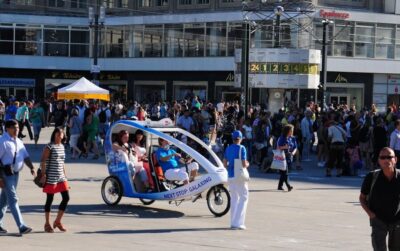
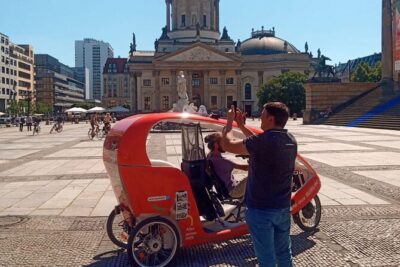
Individual City Tour – Rickshaw Sightseeing in Berlin
Read our review →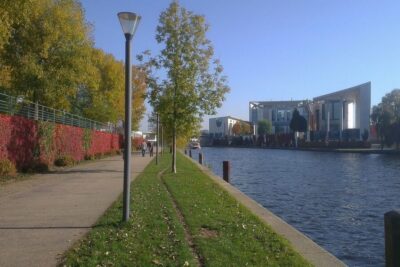

Rickshaw Tours Berlin – Groups of up to 16 people with several rickshaws
Read our review →
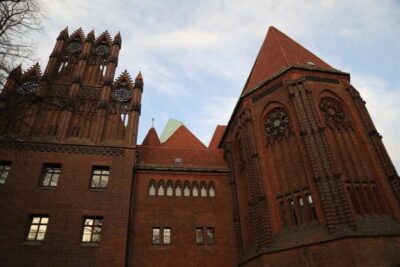
One Up to 3 Rickshaws(6 GUESTS)-Taylor Made Rickshaw Berlin Tour
Read our review →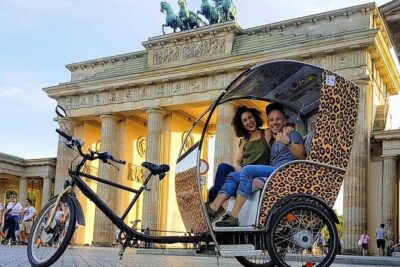
Berlin Rickshaw Tours Historical & Photo City Tour 120min – Sightseeing
Read our review →Browse the lists this tour appears in