
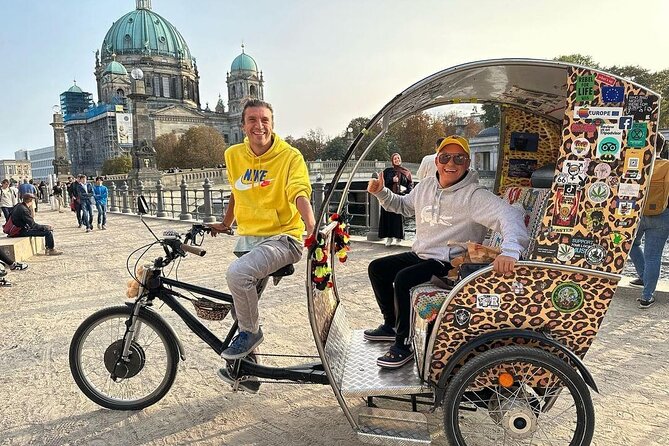
Reviewed · BERLIN RICKSHAW TOURS
Rickshaw Tours Berlin – Groups of up to 16 people with several rickshaws
A rickshaw gives you an easy way to cover Berlin’s major sights without spending the day on foot. I like the close-up ride through central Berlin, where streets and landmarks feel less distant than they do from a bus, and the private format, which lets your group shape the outing around its interests.
The main caution is reliability. Some booked groups report that no guide arrived or that they could not reach the operator, while others describe excellent, prompt service. I’d confirm the meeting plan before setting out, and keep a backup plan if your day in Berlin is tightly scheduled.
- Start at the Brandenburg Gate: The usual meeting point puts you beside one of Berlin’s defining monuments.
- Choose a short ride or a longer circuit: Tours are listed at about one to four hours, so agree on priorities and timing.
- Travel as a private group: Several rickshaws can accommodate a party of up to 16 people.
- See more with less walking: The route can link central sights from the Reichstag to Alexanderplatz.
- Expect guide quality to matter: Guides such as Leo, Hugo and Ufuk receive praise for stories, humor and flexibility.
- Plan for the practical risks: Weather can affect the ride, and reports of missed pickups make confirmation worthwhile.
A rickshaw ride that connects Berlin’s big sights
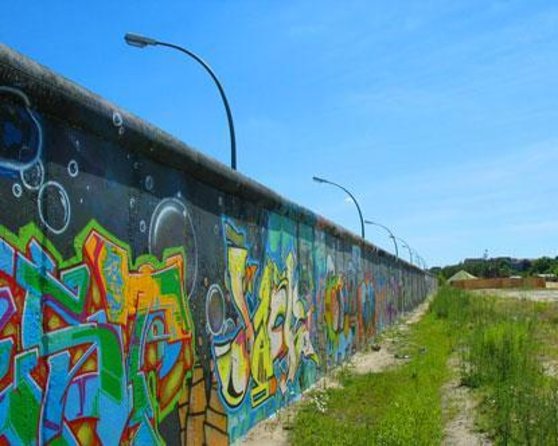
Berlin’s landmarks are spread across a wide area, and its history can feel like a series of separate chapters when you are walking between them. A rickshaw tour helps connect those chapters. You ride between monuments and neighborhoods while your guide points out what happened where, with time to pause for a look or a photo.
This is not a museum visit or a long, detailed lecture at every stop. Several itinerary stops are just a few minutes long, and a one-hour tour cannot sensibly cover every place on the full route. Think of it as a mobile introduction: you get orientation, context and a chance to decide which sites deserve a return visit.
The tour begins and ends at the Brandenburg Gate unless you arrange pickup. The listed duration ranges from about one to four hours, so be clear about what you want to see before setting off. If you have a short stay, focus on the central landmarks. With more time, you can ask for a broader route that includes the Berlin Wall memorial and Alexanderplatz.
The Brandenburg Gate and the Reichstag
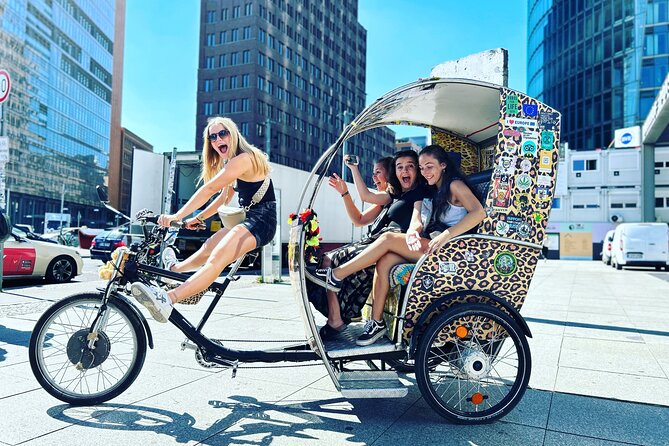
The Brandenburg Gate is a natural starting point. Built between 1788 and 1791, its classical design was inspired by the entrance to the Acropolis in Athens. King Friedrich Wilhelm II wanted a grand end to Unter den Linden, and the result became one of Berlin’s most recognizable sights. From a rickshaw, you can appreciate its scale without having to arrive there already worn out from walking.
The Reichstag is nearby and carries several turning points in German history. In 1918, politician Philipp Scheidemann proclaimed the republic from its west portal. The building was badly damaged in the 1933 fire, and a Soviet flag raised there in 1945 became a symbol of the defeat of Nazi Germany.
The stop is brief, listed at five minutes, and admission to the building is not included. Treat this as an exterior introduction rather than a visit to the dome or parliamentary interior. If you want to go inside, plan that separately.
More rickshaw tours in Berlin:
- Berlin: Private Guided E-Rickshaw Tour
★ 4.9 · 157 reviews - Individual City Tour – Rickshaw Sightseeing in Berlin
★ 5.0 · 120 reviews - Berlin Express: Private 1-Hour E-Rickshaw Ride
★ 5.0 · 116 reviews
The Chancellery and the Soviet memorial
The German Chancellery offers a striking change of style. Its central section rises above lower administrative wings, with broad glass surfaces and large openings that make the building look unusually open for a government complex. The tour’s short pause is enough to take in the architecture, but not to explore the offices or interior.
A little farther along, the Soviet War Memorial in the Tiergarten is a more solemn stop. Two T-34 tanks flank a bronze Red Army soldier, while names of fallen Soviet troops appear on pillars behind him. The rear section contains the graves of around 2,500 soldiers. It is a compact memorial, but its location and scale make it worth slowing down for a moment.
The ride may also pass through the Tiergarten, Berlin’s large central park. It began as a hunting ground and was later reshaped into a public park, including a redesign by landscape gardener Peter Joseph Lenné in the 1830s. Its monuments, bridges and green paths make a welcome break from the city’s stone façades. The exact sights you pass depend on the route and duration.
Potsdamer Platz and the Topography of Terror
Potsdamer Platz shows Berlin in a different register. Once a historic city center, it was rebuilt as a modern district, with high-rises, shops, cafés and cinemas. The contrast between its newer architecture and older parts of Berlin is useful context: this is a city that has repeatedly rebuilt itself, sometimes almost from scratch.
The nearby Topography of Terror brings the focus back to the Nazi period. This site housed major institutions of the SS and police, including the Secret State Police and the Reich Security Main Office. The stop is listed at five minutes, and admission is free. That is enough to identify the place, but you will want more time if you plan to read the outdoor displays or visit the exhibition.
The Gropius Bau is another nearby cultural landmark, devoted to cultural history, contemporary art and photography. The tour allows only a short pause, and entry is not included. Consider this a point of interest to mark for later, rather than a full gallery visit.
Tracing the Berlin Wall and Cold War border
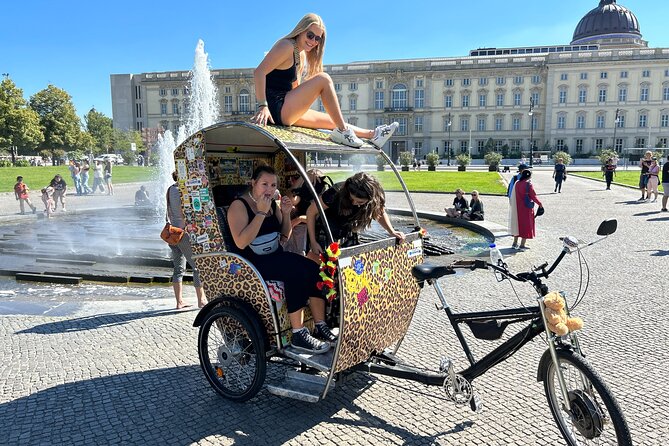
The Berlin Wall Memorial on Bernauer Straße is one of the most important stops for understanding the city’s division. The street became a border between East and West Berlin, and residents faced desperate choices as the Wall went up. Some people tried to escape through the windows of buildings that stood along the boundary. The memorial opened in 1998, marking the anniversary of the Wall’s construction.
The listed stop is only one minute, and admission is not included. That is a quick glimpse, not enough time to take in the memorial grounds. If the Wall is a priority, ask whether the route can give this area more time or plan a separate visit.
Checkpoint Charlie is a different kind of Cold War site. It was the best-known crossing point controlled by the Americans, used by foreigners and certain officials rather than ordinary East Berlin residents. Today, its fame can make it feel more like a busy photo stop than a quiet memorial. The two-minute pause helps you place it in the city’s history, but you may want to explore on foot afterward.
Friedrichstraße runs north to south through Berlin and became a popular shopping street after the Wall fell. Passing through this area helps connect the old border crossing to the reunited city around it. The ride is useful here because it lets you see how quickly the mood shifts from historical checkpoint to everyday city street.
Same city, a different kind of day:
- Berlin: Reichstag, Dome and Government District Guided Tour
★ 4.7 · 18,288 reviews - Berlin: 1-Hour City Tour by Boat with Guaranteed Seating
★ 4.3 · 16,993 reviews - Berlin: Boat Tour Along the River Spree
★ 4.4 · 11,252 reviews - Discover Berlin Half-Day Walking Tour
★ 5.0 · 9,624 reviews
Gendarmenmarkt, Bebelplatz and Museum Island
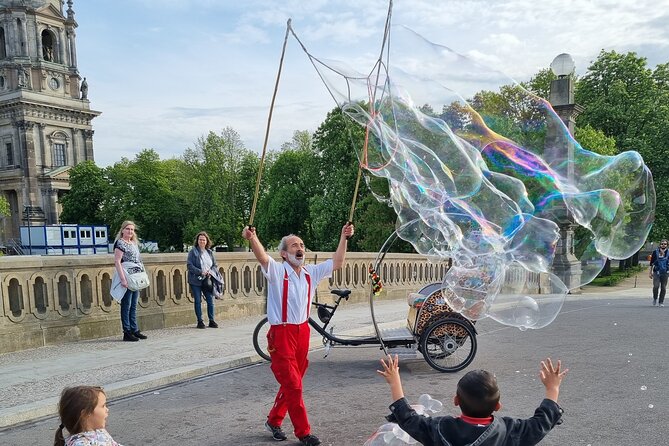
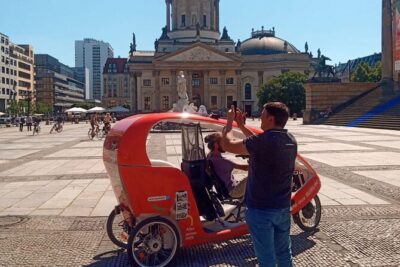
Gendarmenmarkt is one of central Berlin’s most handsome squares. It dates to the late 17th century, when French Protestant refugees settled in the area. Its name came later, from the Gens d’armes regiment, which had its guard and stables there between 1736 and 1782.
The square is framed by the German Cathedral, the French Cathedral and the Konzerthaus. The German Cathedral houses a five-floor exhibition on the development of parliamentary democracy in Germany, but entry is not included. The Konzerthaus is a major work by architect Karl Friedrich Schinkel, with roots in a theater built here in the 18th century. A five-minute stop gives you time to look around, though not to visit each building.
Bebelplatz is a short ride away and is associated with the Nazi book burning of May 10, 1933. More than 20,000 books were burned there, including works by authors such as Erich Kästner, Thomas Mann and Heinrich Heine. The memorial is a reminder that political persecution often begins with attacks on ideas and culture. This is a brief stop, but its meaning is powerful.
Museum Island sits between the Spree and the Kupfergraben. Its museum buildings began with the opening of the Old Museum in 1830, designed by Schinkel, and now house archaeological collections and art. Admission to the museums is not included, and five minutes is only enough to take in the setting. The Berlin Cathedral and Lustgarten are close by, so this part of the route offers a concentrated run of major sights.
The cathedral’s large dome is hard to miss. A visit inside and a climb to the dome are not part of the brief exterior stop, but the view from above is a reason to return on your own. Across from it, the Lustgarten is a traditional public space with rows of linden trees, a large granite bowl and a fountain. It is a pleasant place to pause, especially if you want a calmer moment between monuments.
Alexanderplatz and the shape of the route

Alexanderplatz closes the broad itinerary with a look at eastern Berlin. The square has been a major public gathering and shopping area across different eras, including the 1920s and the GDR period. Today, the television tower, World Clock and Fountain of Friendship among Peoples help give it a distinct character.
This long list of sights should not be mistaken for a promise that every tour visits every stop. The advertised duration varies from one to four hours, and several stops are only one or two minutes long. Before you book, decide whether you care most about the central landmarks, the Wall and Cold War sites, or a wider tour that reaches the eastern city center. Then confirm the intended route with the operator.
What the private format and price get you
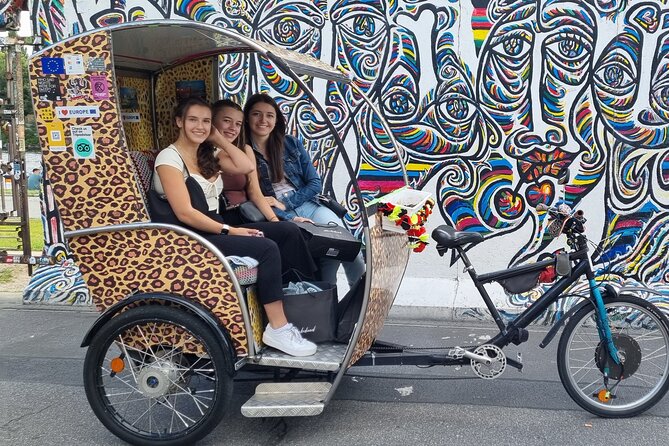
The listed price is $53.10 per person. For a private group, that can be reasonable if you value an easy ride, a guide and the ability to see several districts without organizing multiple public transport changes. It is less compelling if you want long visits inside museums or detailed interpretation at every stop. Those require extra time, and some sites charge admission separately.
Groups of up to 16 are served by several rickshaws, so larger parties will be split among vehicles. That can make the tour sociable, but it also means your group may have more than one driver and guide. A family group described a strong experience with Leo, who shared stories in an engaging way for adults and teenagers. Other groups have praised Hugo for adapting the route, allowing photo stops and taking pictures along the way. Ufuk has also been singled out for accommodating service.
Guide style is central to the value. A good guide can make the ride feel like a conversation about Berlin, not simply a transfer between photo spots. Some customers describe music and humor as part of the outing, and music is available on request. But one group found the speaker too loud and the historical commentary thin. If you care more about learning than music, say so at the start and ask for commentary to take priority.
Wi-Fi, private transportation, a guide, music on request and a photographer are listed as included. The exact way photography is handled is not specified, so ask if taking photos of your group is important. Alcoholic drinks are not included.
Timing, pickup and a few sensible precautions
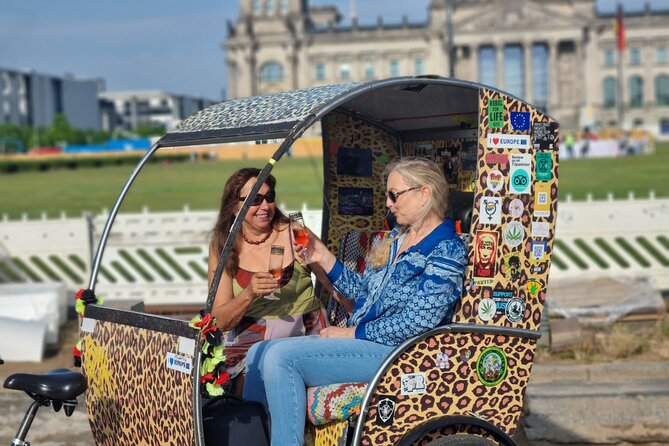
The meeting point is the Brandenburg Gate, and the ride returns there. Pickup is available within two kilometers of the gate; farther pickup costs €10 per kilometer. The tour is booked an average of 34 days ahead, so reserve early if you have fixed dates, but do not assume that an early booking alone settles the meeting details.
The most serious practical concern is that some customers have reported a missed pickup, unanswered calls or messages, and difficulty reaching the operator. Other accounts describe prompt, enjoyable tours, so the service can clearly go well, but the inconsistent reports are hard to ignore. I would confirm your start time and exact meeting point shortly before the tour, save the operator’s contact details, and leave enough flexibility to switch plans if needed.
Weather matters. The activity requires good weather, and a poor-weather cancellation should result in another date or a full refund. The standard cancellation terms allow a full refund if you cancel at least 24 hours before the start; changes or cancellations inside that window are not accepted. Cold weather has also been cited in connection with electric-bike battery problems, so ask the operator to confirm the ride is running if conditions are poor.
A rickshaw reduces the amount of walking, and people with injuries have found it a useful alternative to a walking tour. Still, the supplied details do not guarantee a particular accessibility setup. If you use mobility aids or need help boarding, contact the operator in advance and explain what you need. One account also describes rough driving and a collision with a van, so it is fair to ask your driver to take a cautious pace.
Is this Berlin rickshaw tour worth booking?
Book it if you want a flexible, private overview of Berlin and would rather ride between landmarks than cover the distances on foot. It can be especially useful for families, small groups, people with limited stamina, or anyone short on time who wants an introduction before choosing which sites to visit properly.
I would hesitate if you need guaranteed punctuality, want a deep historical tour, or have only one tightly planned window in Berlin. Confirm the pickup and route, ask for the kind of commentary you want, and keep a backup plan. With a reliable guide such as Leo or Hugo, the rickshaw can be a fun and practical way to connect Berlin’s monuments. Without clear confirmation, the operational uncertainty deserves serious weight.
FAQ
How long is the rickshaw tour?
The listed duration is approximately one to four hours. The sights covered depend on the time you choose and the route arranged.
Where does the tour start and end?
The meeting point is the Brandenburg Gate, and the activity ends back at that meeting point.
Is hotel pickup available?
Pickup is included within two kilometers of the Brandenburg Gate. Pickup farther away costs €10 per kilometer.
How many people can join?
The tour is private, with several rickshaws available for groups of up to 16 people.
Are attraction admission fees included?
No. Admission is not included at sites such as the Reichstag, Gropius Bau, German Cathedral, Konzerthaus, Museum Island and Berlin Cathedral. Several outdoor stops are free.
What happens if the weather is poor?
The activity requires good weather. If the operator cancels because of poor weather, you will be offered another date or a full refund.
Newest tours in Berlin
- Berlin: guided canoe | kayaktour★ 4.1 · 7 reviews
- Understanding Kreuzberg: The roots of local (sub)culture★ 4.9 · 11 reviews
- Where It All Began: Berlin’s Queer & Trans History Tour★ 4.9 · 6 reviews
- Warnemünde Shore Excursion: Private Sachsenhausen and Berlin Tour★ 5.0 · 12 reviews
- Ultimate E-Bike Tour of Berlin with Beer Garden Stop★ 5.0 · 4 reviews
- Potsdam Highlights – Private sightseeing tour by minibus★ 5.0 · 3 reviews
- Private Potsdam City Tour in an authentic vintage van★ 5.0 · 14 reviews
- Transfer from Berlin Schönefeld Airport (SXF) to Berlin city Hotels – ROUND TRIP★ 4.0 · 3 reviews
Berlin Rickshaw Tours, compared.
Individual City Tour – Rickshaw Sightseeing in Berlin
Read our review →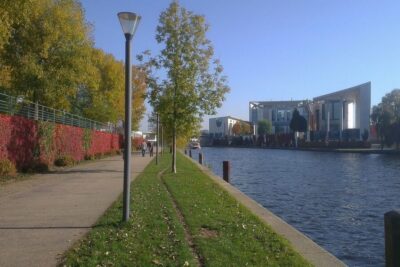

One Up to 3 Rickshaws(6 GUESTS)-Taylor Made Rickshaw Berlin Tour
Read our review →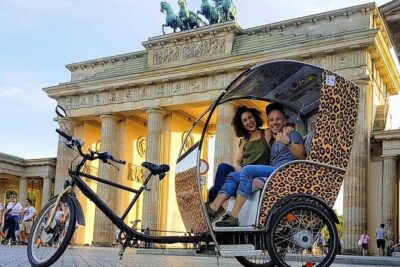
Berlin Rickshaw Tours Historical & Photo City Tour 120min – Sightseeing
Read our review →
Daily First Rickshaw promotion in Combi Vehicle public Group 90€
Read our review →Browse the lists this tour appears in